Ross Procedure: 10+ Important Facts for Patients
Written By: Adam Pick, Patient Advocate, Author & Website Founder
Medical Experts: Paul Stelzer, MD, Co-Director of the Heart Valve Center, and Ismail El-Hamamsy, MD, Director of Aortic Surgery, Mount Sinai Hospital
Page last updated: April 16, 2024
Any heart valve diagnosis that necessitates surgery is cause for contemplation. Any decision for or against a cardiac procedure should be an informed one.
Medical interventions have come a very long way over the years, making aortic valve replacement safer and more effective. Still, it is normal, and advisable, to ask for clarification of the highly technical terms and procedures patients may consider.
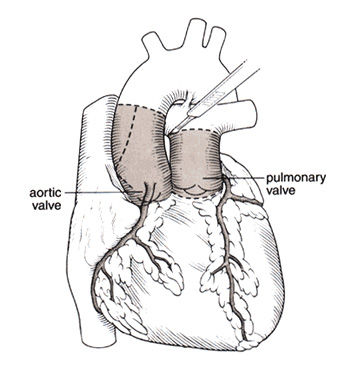
The Ross Procedure is an advanced form or aortic valve replacement that is experiencing a renaissance around the world. Now, more than ever, patients are asking important questions like:
- What is the Ross Procedure?
- When is it used?
- How is the Ross Procedure performed?
- Are there other interventions, surgical or otherwise, that I can consider?
- What type of heart valve devices will be used to replace my stenotic or leaky heart valve?
- Will this procedure necessitate open heart surgery or is there another method choice?
- How long will it take me to recover following this procedure?
- Is this a long-term solution to my failing valve problem?
To answer these important questions, it often helps patients to approach this surgical option in bite-sized pieces that provide a holistic understanding of the heart and the Ross Procedure.
Anatomy and Function of the Heart
A human heart weighs less than a pound, beats an average of 100,000 times a day, and is responsible for the collection and disbursement of waste from and the delivery of life-giving oxygen and nutrients to the body’s trillions of cells. The heart is made up of four chambers.
- Right atrium
- Right ventricle
- Left atrium
- Left ventricle
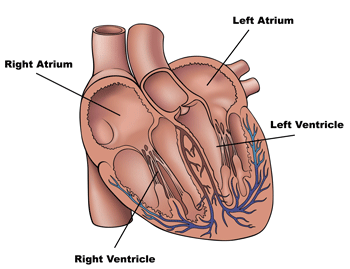
Our blood flows in one direction through four valves found between each chamber of the heart. The right atrium receives non-oxygenated blood from the superior and inferior vena cava. The blood is then pumped through the tricuspid valve and into the right ventricle. The right ventricle then pumps the blood through the pulmonary valve where it enters the lungs.
Once the blood has been relieved of its waste products and re-oxygenated, it is received by the left atrium. The left atrium pumps it through the mitral valve and into the left ventricle. The left ventricle pumps the oxygenated blood out to the aorta and the rest of the body through the aortic valve.
Aortic Valve Disease
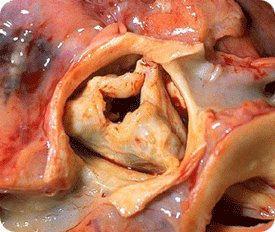
The aortic valve can become stiff and inflexible causing narrowing of the aortic valve thus decreasing the outward blood flow. This is called aortic stenosis. Blood backs up into the left ventricle when the aortic valve does not close properly. Another form of aortic valve disease is aortic regurgitation in which blood leaks backwards into the heart. Similar to stenosis, an aortic valve that leaks may cause serious problems for patients who do not get treatment.
 Aortic Stenosis
Aortic valve abnormalities can be congenital (deformation from birth), due to old age (calcium deposits over time), caused by infection (endocarditis), or related to rheumatic fever. The most common congenital heart defect is a bicuspid aortic valve that can lead to both aortic stenosis and/or aortic regurgitation.
Interestingly, many people diagnosed with aortic valve disease are asymptomatic. However, other patients can experience symptoms including:
- Fatigue
- Swollen ankles
- Shortness of breath
- Heart palpitations
- Dizziness
When diagnosing an aortic valve disorder, your doctor might hear a murmur, indicating turbulent blood flow through your aortic valve, while listening to your chest with a stethoscope. An echocardiogram (a gel-covered probe is placed on the chest to transmit images) is commonly utilized in the diagnostic progress. There are other tests not listed here that a doctor may choose to help in determining the severity of the problem.
Aortic Valve Treatment Options
A doctor may suggest aortic valve treatment based on the severity of the disease and symptoms, a person’s age, and the disease progression. Treatments can vary from careful monitoring by your physician to surgical repair or replacement of the aortic valve. Statistics point to most aortic valve dysfunctions needing surgical intervention at some point.
A non-surgical approach for aortic valve dysfunction is balloon valvuloplasty. A balloon is attached to a special catheter and inserted through an incision in the groin. The catheter is threaded up to reach the aortic valve where the physician blows the balloon up and deflates it several times until he is satisfied with the dilation achieved. The catheter and balloon are then removed.
Another non-surgical treatment is transcatheter aortic valve replacement or TAVR. The surgeon can choose to enter the femoral artery or make a small incision in the chest and enter through a large artery. A new valve is delivered to the inside of the diseased valve and acts somewhat like a stent. Once the new valve expands it takes over for the old valve.
As aortic valve disease is a structural heart condition, there are no medications that will repair a leaky or stiff aortic valve. However, there are medications that can help manage symptoms and improve the quality of an individual’s life.
In the past, patients with malfunctioning aortic valves had no choice other than surgical replacement of the valve with an animal, mechanical, or human valve (also known as a homograft). Medicine has evolved and grown over the years now providing patients with repair options as well. There are many criteria used to determine whether valve repair is in the client’s best interest. The most important of these criteria is whether a repaired valve will last longer than a prosthetic one. In this video, you can watch Dr. Alfredo Trento describe the different types of heart valve replacements.
When your cardiologist and surgeon decide a replacement valve is necessary, there remains the decision regarding the procedure type used for the replacement. During valve replacement surgery, the diseased valve is removed and replaced by an animal, mechanical, or human valve.
Traditional heart valve surgery involves the surgeon making an incision into the middle of your sternum to gain direct access to your heart. There are minimally-invasive techniques that mean smaller incisions and decreased blood loss. However, each patient’s needs are unique thereby requiring an evaluation by a seasoned and knowledgeable cardiac surgeon.
The Ross Procedure
For many children and young adults, the Ross Procedure provides an advanced form of aortic valve replacement that has been used since the late 1960s when it was developed by Dr. Donald Ross.
During the Ross Procedure (also known as the Switch Procedure), the surgeon first removes the patient’s aortic valve. Then, the surgeon carefully removes the patient’s pulmonary valve (now called an autograft) and uses it to replace the diseased aortic valve. A donor valve, usually a human homograft valve, is then sewn in to replace the pulmonary valve.
This procedure is highly effective because the pulmonary valve is shaped much like the aortic valve and is used to handling a large volume of blood flow. The human donor valve now in the pulmonary position is less likely to fail as it is under less stress due to the lower pressure necessary to move the blood into the lungs.
Ross Procedure Advantages
While the Ross Procedure is a very complex procedure, the benefits of this type of valve replacement appear to weigh heavily on the plus side.
- There is less need for mandatory use of life-long anticoagulants.
- The autograft can grow with children.
- The autograft is live tissue that can communicate with other cells in the body.
- There is longer (20+ years) documented freedom from cardiac-related death or reintervention versus mechanical valve replacement.
- Studies also show a reduced incidence of stroke and post-operative bleeding.
- Patients reported a better quality of life years after aortic valve replacement utilizing the Ross Procedure.
Following the Ross Procedure, a patient can expect to stay hospitalized for four to five days. While each patient recovers at their own pace, there is typically about an eight-week period of limited activity with a return to normal activities gradually over three to four months. Always follow your physician’s recommendations as each person is, as I said previously, unique.
Ross Procedure Surgeons
As mentioned above, the Ross Procedure is a very complex operation. For this reason, the procedure should only be performed by surgeons who specialize in this double-valve operation. Current Ross Procedure specialists in the United States include:
- Dr. Paul Stelzer, Mount Sinai Hospital, New York City, New York
- Dr. Ismail El-Hamamsy, Mount Sinai Hospital, New York City, New York
- Dr. Vaughn Starnes, Keck Medicine of USC, Los Angeles, California
- Dr. Alfredo Trento, Cedars-Sinai Medical Center, Los Angeles, California
- Dr. Chris Malaisrie, Northwestern Medicine, Chicago, Illinois
- Dr. Christopher Burke, UW Medicine Heart Institute, Seattle, Washington
Ross Procedure Educational Webinar
On November 18, 2020, HeartValveSurgery.com hosted a live educational webinar to help patients learn about the Ross Procedure. The 60-minute webinar, which featured Dr. Paul Stelzer and Dr. Ismail El-Hamamsy, provided fascinating insights about the advantages of the Ross Procedure and debunked several myths about this misunderstood cardiac operation. To watch a playback of the webinar, please click the play button below.
Ross Procedure Patient Success Story
To help you learn more about the advantages of the Ross Procedure, this educational video reveals the patient success story of Peter Woglom, an aortic valve patient who selected the Ross Procedure to treat his aortic valve disease. This video also features Dr. Paul Stelzer who has performed over 740 Ross Procedures, more than any other surgeon in the United States.
There exists a myriad of choices for the treatment for aortic valve disease. When patients decide on one form of treatment, many factors should be considered. The most important of these is which will provide the best quality-of-life and the longest durability given your age and lifestyle. This article was provided to help you learn more about the Ross Procedure as you research your heart valve treatment options.
Keep Learning About The Ross Procedure
- Patient Alert: Ross Procedure Survival Advantages
- New Ross Procedure eBook & Webinar Video Posted!
- Research Update: Advantages of the Ross Operation
- Annual Estimates for the Ross Operation
- Autograft Valve Wrapping Techniques
- Age Limits for the Ross Procedure?
Resources:
Michigan Medicine
-https://healthblog.uofmhealth.org/heart-health/anatomy-of-a-human-heart
University of Nottingham
-https://www.nottingham.ac.uk/nursing/practice/resources/cardiology/function/anatomy.php
Cleveland Clinic
-https://my.clevelandclinic.org/health/treatments/16745-aortic-valve-surgery
Columbia University Medical Center
-https://www.congenitalheart.cuimc.columbia.edu/conditions-we-treat/congenital-aortic-stenosis
Mayo Clinic
-https://www.mayoclinic.org/tests-procedures/aortic-valve-repair-aortic-valve-replacement/about/pac-20385093
American Heart Association
-https://www.heart.org/en/health-topics/heart-valve-problems-and-disease/understanding-your-heart-valve-treatment
WebMD
– https://www.webmd.com/heart-disease/valve-disease-treatments#3-7
AHA Journals
-https://www.ahajournals.org/doi/10.1161/CIRCULATIONAHA.116.024305
Journal of the American Medical Association
-https://jamanetwork.com/journals/jamacardiology/fullarticle/2698187
Mount Sinai Hospital
-https://www.mountsinai.org/care/heart/services/aortic/surgery/ross
Written by Adam Pick
- Patient & Website Founder