

Larry's Guest Post: Heart Valve Surgery, Family Travel & 6,200 Miles of Memories
Written By: Larry Reese, Heart Valve Patient
Reviewed By: Adam Pick, Patient Advocate, Author & Website Founder
Published: July 8, 2026
Heart valve surgery can be a very trying and scary time. Fortunately for most patients, such as those with a bicuspid aortic valve, one will generally have time to plan their surgery. Nevertheless, that extra time itself can add unforeseen complications. This short monograph will share my experiences in the hopes it proves useful to other patients who might be in a similar situation.

I was born with a bicuspid aortic valve but, like many, lived most of my life completely unaware of it. I married and had children late. In my late 40s and early 50s some hints of the bicuspid valve began to make an appearance. I did not notice a dramatic change but I was, and am, also overweight which may have hidden some of the symptoms. Eventually, my cardiologist conclusively diagnosed the bicuspid valve, so we knew surgery was definitely in the future. We monitored the valve for many years with bi-annual visits to the cardiology team 500 miles away. With a BAV the size of the annulus is a key indicator - once it has narrowed to under 1 cm it is generally considered surgery time. Mine reached one cm, however, but did not immediately continue narrowing. It hung there, and for several years there was no change. We continued living life.
In the spring / summer of 2025, the visit revealed little apparent change, and we returned home on schedule but with a warning from the doctor that I would likely need surgery inside two years. Keeping that timeline in mind, I decided that it was time to plan a big summer trip with my wife and children. I had been thinking about this for some time, since I had become aware that heart surgery was certain. Travelling extensively by car was something I had enjoyed very much with my own parents and that I wished to share with my children. A kind of “once in a lifetime” kind of thing. There was more to it, of course; I am very methodical and plan for the worst, but hope for the best. Because of my being overweight, now in my late fifties, and with other comorbidities like diabetes, I wanted to do something with my family that would mark this time and give them a big, unique experience to remember in case we were unable to do something like that later either because of physical limitations or because I was no longer around.

The trip I put together took us from West Texas through New Mexico, Arizona, California, Oregon, Washington, Idaho, Montana, British Columbia, Alberta, Wyoming, and Colorado. I had reserved houses with multi-night stays along the way near the attractions I wanted to emphasize, but some overnight stays were just way point stops for the night. As planned, the trip would comprise ~ 6,500 miles and take 18 to 20 days. In its final form, it measured 6,200 miles and took a truncated 16 days. Among the stops of note were the Valley of Fire, the Very Large Array, the Grand Canyon, Meteor Crater, Hoover Dam, Las Vegas (a mere mirage in the distance), Furnace Springs and Death Valley, Cambria on the California coast, Yosemite, San Francisco and the Bay Area, Portland, Glacier National Park, Yellowstone, Cody (Wyoming), and Colorado.
I had seen nearly all of these places before, but none of my family had, and it had taken me most of my adult life. Exposing my children to them now would be a great experience but also would allow them in the future to decide, for example, if they wanted to come back and spend more time at a particular place, or places, in the future. All of this was meticulously planned out and booked a year in advance to make sure we could get lodging we wanted, close to what we wanted to see and experience. We would not be driving every day, but there were two instances where there were very long hauls back to back. The family was very much looking forward to the trip.

Right before Christmas, however, while I was with my wife for a follow-up with her doctor for a foot surgery, the cardiology team called and said further review indicated I needed to have surgery “right now” (within 6 months). Even though I had been aware for years that surgery was coming I had seemingly relaxed into a complacent state again when the office visit and initial review of the scans had been unremarkable. Now it was real. So I set about finding my surgeon and hospital myself. I had previously determined that the 2 “top ranked” heart surgery hospitals where my primary cardiologist was located were not sufficiently well scored in my specialty (particularly with infection control, readmissions, etc…) and selected one in another city instead.

In the back of my mind at this time, was concern that we had already committed to the trip and reserved everything up front, which was a sizable financial investment. I tried to look at it logically, that if the worst happened and I passed away, the family could still make the trip and enjoy it; if I came out of it very well, we could still attempt it if the risk seemed minimal, and that if I could not make it because of complication or immobility, they could still make the trip without me or with a friend or relative along to help.
After considerable research, I selected Dr. Justin Schaffer to be my cardiac surgeon at Baylor Scott & White - The Heart Hospital in Plano, Texas. Dr. Schaffer has over 100 patient reviews at HeartValveSurgery.com.

Dr. Justin Schaffer (Larry's Heart Surgeon)
Surgery went as well as could be expected. Everyone has delirium afterwards at points according to hospital staff and my pre-surgery research (limited though it was) and I had it as well. While I understood what was happening, I was locked in that state and did not enjoy it. Further down the road, I also experienced, and continue to experience, some vision disturbances as well, including the inability of my brain to interpret and integrate what both my eyes are seeing.
What I mean by this is, when it occurs, I suddenly become dizzy with little warning and, while not blind, have an incredibly hard time understanding what I am seeing. By experimentation I finally discovered that if I closed one eye (either one) I could see fine, so it would appear the issue is with my brain being able to coordinate and integrate those two “pictures” being sent from the eyes and form a 3D image out of them. But, back to our story. I was off the ventilator very early and seemed to be doing well. One nurse practitioner said she thought I might be discharged 3 or 4 days early which alarmed my wife (I was out whenever that statement was made). The surgeon quickly quashed this idea when he was told by my wife about that statement.
Consulting with Medical Professionals
If you are in a similar situation, this is major surgery and undertaking such a trip so shortly thereafter should not be decided upon lightly. Both my surgical team and my treating physicians stated they “wished I had 6 months” or more between the surgery and the trip to which I replied “Me too!” But, as the follow-ups seemed to be showing things were going pretty well, they stopped short of saying “don’t do it.” My wife and I decided to go with the understanding that, for example, I would not do any heavy lifting (suitcases included), extended exertions, or the like, and that if there were complications the trip would end immediately. With hindsight my wife wished we had gotten specific recommendations in writing for easy reference.

Vehicle Related Considerations
While these are of course important they will be heavily dependent on the type of vehicle you have available so I will offer just a few minor thoughts. We were two adults and three teenagers necessitating a large vehicle. We happened to have a 2019 Ford Expedition Max (the Max designation, and before it the EL designation, denotes an extra 18” or so of body length, so even more room in the passenger compartment) and it served us well. These are three-row vehicles sized to suit adults in all rows. Although not new by any stretch of the imagination, we had owned it more than a year at this time and I knew the vehicle and its idiosyncrasies well. I keep our vehicles well maintained and had no concerns starting a long trip like this with well over 100,000 miles on the odometer. If your vehicle is an unknown or relatively newly purchased used car you might consider a rental if the trip is long or into areas where service and assistance may be few and far between. Personally, I would not trust even a mechanic's inspection to be able to certify an extremely long trip like this; much better to rely on a long personal history with the vehicle. Several years of ownership had given me a comfortable sense that I knew where we stood with this vehicle.
Another recommendation is, if possible, to keep items in the passenger compartment to a minimum. Hours in a vehicle are made much worse if people feel cramped or confined. My solution was to use a steel cargo basket that attaches to the rear hitch receiver. Putting a locking, rubber, heavy duty cover in the basket, protects the luggage from exposure, the elements, and potential theft, while its location at the back of the vehicle (instead of on a roof rack) preserves the vehicle’s aerodynamics and gas mileage (such as it is), and makes it easy to access whenever needed.
Even so, confined quarters in the vehicle did occasionally contribute to frayed tempers and irritability. Nevertheless, we tried to keep a focus on the big picture. Looking back now, for my family those disagreements pale to insignificance (mostly!) compared to their other recollections. For me, though, I remember them and am considering ways to further minimize such situations on any future trips.

8 Patient Recommendations (not directly related to travel after heart valve surgery)
A. If you are going to plan a similar trip, with a similar chance of it suddenly being interrupted by surgery, consider paying for and planning the trip in a different way than I did. One that does not lock you into a given speed of travel and risk one broken link in that chain potentially derailing the entire rest of the trip. While you can save money and have a better selection of places to stay because one is reserving dates so far in advance, it also runs the risk of locking you into a limited amount of time at any given location (we found twice that we would have liked to spend another day or two at particular locations, but were not able to do so). Consider if your travel style and finances would allow you more flexibility than we had.
B. If you are taken for imaging shortly after surgery, make sure a family member goes as well. I had to have an MRI after surgery and, as it turned out, neither my wife nor other family members happened be around when the call came. I did not want to delay the imaging for obvious reasons so I agreed to go even though I was still not “myself.” Not having someone there to advocate for oneself can leave you trying to handle things when you still have limited faculties due to anesthesia, etc…. The MRI staff were reluctant to try and help me onto the table both because of my size (they were small ladies) and because of my immediately preceding surgery. Had my wife, family, or friends been with me, I am sure they would have been better advocates for additional help than I was able to be.

C. I found the medical rankings and evaluations of heart hospitals to be incredibly useful in selecting a hospital as a whole. Many hospitals do not publish this data, but for those that do, US News & World Report’s “Best Hospitals for X” (in my case aortic valve surgery) collates the hospitals’ reports and analyzes data down to very specific sets (for example, the incidents of post-surgical infection) and makes it all available to the public. This can greatly assist in providing some concrete data to compare when assessing hospitals. I highly recommend reading the section on how they weight the data to come up with the final rankings. If memory serves, some 15% is often “reputational,” which roughly equates to how “experts in the field” rate the facility. While I do realize this can be a reasonable criterion, I tended to weight the outcome/results data a little more heavily. Find a methodology you are comfortable with.
D. Talk to your medical and surgical teams about any proposed trip in as much detail as they feel they need. Be willing to listen to what they say. It may just be something that should not be undertaken depending on the specific situation.
E. Be flexible on the trip itself. We abandoned several stops in Colorado when everyone, not just me, were getting worn out. I had purposely left some slack in the latter portion of the trip to accommodate just such a possible need (for example, having booked in hotels which generally are refundable as opposed to vacation rentals where you will lose most if not all of that payment). Let the plan be a guide, but not a set of rails you cannot get off of if you need to do so.
F. If you’re on blood thinners, plan your testing so you can continue to adjust the dosage during the trip. You should have a basic idea of when you need testing, and when you’ve mapped out the trip, plan it in a way that makes certain you have access to a hospital and/or lab that can provide you with the test data you need. I was scheduled to test every 10 to 14 days and tweaked the trip scheduling so that I would likely only need to test once while on the trip. I then had the lab send the results to my treating physician (or called him with it myself) and he used that information to calculate the appropriate dosage and adjusted it on the fly from 1,400 miles away. Plan this in advance with your Primary Care doctor’s office so there is no surprise for them, and (if you can) plan where you will be for the testing so there is no last-minute rush to find a lab, get set up as a patient, etc…. I would like to thank Logan Health in Whitefish, Montana, and their patient intake staff and lab technicians for their dedication, professionalism, and willingness to figure out how to get everything set up to help my family and me take proper care of me. They were exceptional.

G. Be careful of exertion. While in the moment you may feel perfectly fine, travelling can tempt you to see yourself as fitter than you are in my experience. Talk to the people you’re with. My wife pointed out to me quite strongly at one point that I should not have been lifting a given suitcase and she was absolutely correct to do so.
H. Keep in mind the risks you’re taking. We did not set any particular boundaries, given the potential risks were so broad and diverse, but do not ignore signs or symptoms. Safe is always better than sorry.
Related Links:
See 100+ Patient Reviews for Dr. Justin Schaffer, Larry's Heart Surgeon
After Crossing Antarctic Circle, Ed Salutes Dr. Marc Gillinov
I wish you all many happy travels and memories!
Larry Reese
Written by Adam Pick
Patient & Website Founder

Written by Adam Pick - Patient & Website Founder
Adam Pick is a heart valve patient and author of The Patient's Guide To Heart Valve Surgery. In 2006, Adam founded HeartValveSurgery.com to educate and empower patients. This award-winning website has helped over 10 million people fight heart valve disease. Adam has been featured by the American Heart Association and Medical News Today.
Comments





Adam's Newest Blogs


New Community Posts
Blog Categories
- Adam's Updates
- Aneurysms
- Aortic Stenosis
- Aortic Valve Repair
- Aortic Valve Replacement
- Atrial Fibrillation
- Before Surgery
- Bicuspid Aortic Valve
- Heart Valve Replacement
- Medical Technology
- Mitral Regurgitation
- Mitral Valve Repair
- Patient Stories
- Pulmonary Valve
- Recovery
- Ross Procedure
- Surgeons & Hospitals
- Tricuspid Valve
Blog Categories
- Adam's Updates
- Aneurysms
- Aortic Stenosis
- Aortic Valve Repair
- Aortic Valve Replacement
- Atrial Fibrillation
- Before Surgery
- Bicuspid Aortic Valve
- Heart Valve Replacement
- Medical Technology
- Mitral Regurgitation
- Mitral Valve Repair
- Patient Stories
- Pulmonary Valve
- Recovery
- Ross Procedure
- Surgeons & Hospitals
- Tricuspid Valve
Blog Categories
- Adam's Updates
- Aneurysms
- Aortic Stenosis
- Aortic Valve Repair
- Aortic Valve Replacement
- Atrial Fibrillation
- Before Surgery
- Bicuspid Aortic Valve
- Heart Valve Replacement
- Medical Technology
- Mitral Regurgitation
- Mitral Valve Repair
- Patient Stories
- Pulmonary Valve
- Recovery
- Ross Procedure
- Surgeons & Hospitals
- Tricuspid Valve
The Patient's Guide
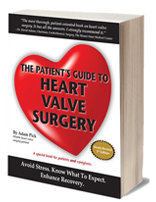
This book has helped over 47,000 patients and caregivers from diagnosis to recovery.

New Posts From Our Community


Pamela Gregory from
Newark, Delaware
Today marks 4 years since Dr. Roselli gave me a new...
Meet Pamela
Newest Community Post

Find Heart Valve Surgeons
Search 1,500 patient-recommended surgeons
The Patient's Guide
This book has helped over 47,000 patients and caregivers from diagnosis to recovery.
