

Ross Procedure Complications?
Written By: Adam Pick, Patient Advocate, Author & Website Founder
Page Last Updated: May 20, 2025
After I was diagnosed with severe stenosis and regurgitation in my bicuspid aortic valve, I was required to make a pretty significant decision.
Since the echocardiograms showed that my aortic valve was beyond heart valve repair, I needed heart valve replacement surgery. (FYI, I had two echocardiograms to confirm my heart valve condition. I highly, highly, highly encourage you do the same. Second opinions are critical.)
That said, I had to answer the question, "What type of heart valve replacement surgery should I have?"
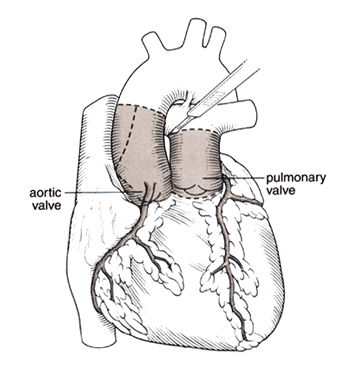
The Ross Procedure
In talking with my cardiologists, potential surgeons and my family, I selected the Ross Procedure. It was not an easy decision to make. But, given my active lifestyle and the Ross Procedure statistics, I still think the double valve replacement surgery was the best option for me. I am writing about this today because I just received a question that reads, "Adam... Are there more Ross Procedure complications than other heart valve replacement surgery complications?" To learn more about this Ross Procedure, click here.
To be honest, I do not have any quantitative data to compare Ross Procedure complications against other heart valve replacement surgery complications (e.g. the use of mechanical valves, tissue valves, pig valves, cow valves, etc.).
However, the Ross Procedure is a more technically challenging surgery for the cardiac surgeon to perform. You have to remember that in the Ross Procedure both the pulmonary and aortic valves are removed. You may think that a double valve replacement would directly correlate to double the risk... and double the complications. There may be some truth to that.
However, if you do your diligence and find the right surgeon who is highly skilled and proficient in the Ross Procedure (e.g. Dr. Vaughn Starnes), the complications may be on par with other heart valve replacement procedures.

What's most interesting about heart valve surgery complications and Ross Procedure complications is the patient perspective on what constitutes a perceived complication following heart surgery. I recently surveyed 78 former patients to better understand their post-operative experience. As you can read, 66% of patients experienced a "perceived" complication following heart surgery.
That's pretty high, right?
Maybe, but I stress the fact that these are perceived complications not clinically stated complications.
Well. I hope that answers the question about Ross Procedure complications.
Keep on tickin!
Adam
Written by Adam Pick
Patient & Website Founder

Written by Adam Pick - Patient & Website Founder
Adam Pick is a heart valve patient and author of The Patient's Guide To Heart Valve Surgery. In 2006, Adam founded HeartValveSurgery.com to educate and empower patients. This award-winning website has helped over 10 million people fight heart valve disease. Adam has been featured by the American Heart Association and Medical News Today.
Comments





Adam's Newest Blogs


New Community Posts
Blog Categories
- Adam's Updates
- Aneurysms
- Aortic Stenosis
- Aortic Valve Repair
- Aortic Valve Replacement
- Atrial Fibrillation
- Before Surgery
- Bicuspid Aortic Valve
- Heart Valve Replacement
- Medical Technology
- Mitral Regurgitation
- Mitral Valve Repair
- Patient Stories
- Pulmonary Valve
- Recovery
- Ross Procedure
- Surgeons & Hospitals
- Tricuspid Valve
Blog Categories
- Adam's Updates
- Aneurysms
- Aortic Stenosis
- Aortic Valve Repair
- Aortic Valve Replacement
- Atrial Fibrillation
- Before Surgery
- Bicuspid Aortic Valve
- Heart Valve Replacement
- Medical Technology
- Mitral Regurgitation
- Mitral Valve Repair
- Patient Stories
- Pulmonary Valve
- Recovery
- Ross Procedure
- Surgeons & Hospitals
- Tricuspid Valve
Blog Categories
- Adam's Updates
- Aneurysms
- Aortic Stenosis
- Aortic Valve Repair
- Aortic Valve Replacement
- Atrial Fibrillation
- Before Surgery
- Bicuspid Aortic Valve
- Heart Valve Replacement
- Medical Technology
- Mitral Regurgitation
- Mitral Valve Repair
- Patient Stories
- Pulmonary Valve
- Recovery
- Ross Procedure
- Surgeons & Hospitals
- Tricuspid Valve









The Patient's Guide
This book has helped over 47,000 patients and caregivers from diagnosis to recovery.
New Posts From Our Community

Kevin Mulcahy from
Kingsport, Tennessee
Arrived at NYP this afternoon for my cardiac catherization. Test was...
Meet Kevin
Clifford Fava from
Milford, Connecticut
So Cardio Version didn't work. Should I try ablation next>
Meet Clifford
Kate Griffith from
Virginia Water, United Kingdom
I wanted to share this medical research news -- how wonderful...
Meet KateNewest Community Post
Kevin Mulcahy from
Kingsport, Tennessee
Arrived at NYP this afternoon for my cardiac catherization. Test was...
Meet Kevin
Find Heart Valve Surgeons
Search 1,500 patient-recommended surgeons
The Patient's Guide
This book has helped over 47,000 patients and caregivers from diagnosis to recovery.