

Minimally Invasive vs. Sternotomy: Which is Best for Heart Valve Patients?
Written By: Allison DeMajistre, BSN, RN, CCRN
Medical Expert: Juan Pablo Umana, MD, Chief of Cardiac Surgery, University of Miami Health System, Miami, Florida
Reviewed By: Adam Pick, Patient Advocate, Author & Website Founder
Published: July 30, 2026
Advancements in medical technology have expanded surgical techniques, giving heart valve surgeons and their patients more options than ever when planning an operation. A traditional sternotomy, where the breastbone is cut open, used to be the only way to access the heart. Now, minimally invasive techniques using 2 to 4 small incisions in the chest wall make it possible for patients to have a shorter hospital stay, less pain, and faster overall recovery. Given the two options, the easy choice for most patients would be a minimally invasive approach. However, there’s a lot more that goes into the decision for both patients and surgeons.
We recently received a patient question on this subject from Robert, who asked, “For my upcoming heart valve surgery, I’m evaluating different surgical approaches with different size incisions resulting from sternotomy or minimally invasive. I’m a bit lost. What do the experts think is the most important criterion for patients to consider for their surgery?” To answer Robert’s question, Adam Pick, founder of HeartValveSurgery.com, spoke with Dr. Juan Pablo Umana while they were attending the American Association for Thoracic Surgery meeting in Chicago, Illinois. Dr. Umana is the Chief of Cardiac Surgery at the University of Miami Health System in Miami, Florida, where he specializes in minimally invasive heart surgery.
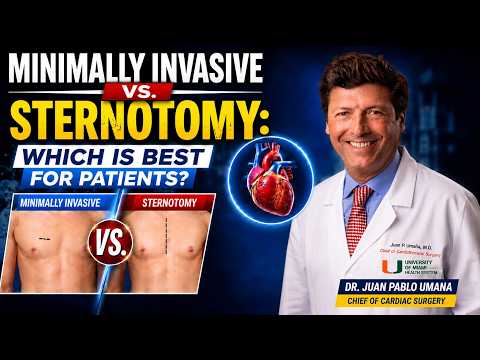

Video available online at:
https://www.youtube.com/watch?v=TfAt-Wz_cPw
Facts About Sternotomy vs. Minimally Invasive
Here are the key insights shared by Dr. Umana:
The type of incision is dependent on the operation. Dr. Umana said, “The important thing is what is done inside. How we get there and what access we use should be totally secondary. Depending on the operation you need, whether it’s a valve sparing root replacement, a Ross procedure, or an aortic valve replacement versus an aortic valve repair, we can start tailoring the type of incision needed to perform the operation.” Dr. Umana explained that a minimally invasive approach is ideal for a standard aortic valve replacement. “It’s better cosmetically and probably has a faster recovery.” However, Dr. Umana said that the size of the incision becomes secondary in procedures such as an aortic valve repair, re-implantation, root remodeling, or a Ross procedure.

A surgeon decides on incision type to achieve better overall goals. “I think the main message is that we do the right operation for the right patient, and the incision must be tailored according to what operation is going to best suit the patient. We look at what will make a patient’s life better, increase life expectancy and quality of life while also recovering heart function.”
Thanks Dr. Umana and the University of Miami Health System!
On behalf of all the patients in our community, thank you, Dr. Juan Pablo Umana, for everything you and your team are doing at the University of Miami Health System in Miami, Florida!
Related links:
Ask Dr. Juan Pablo Umana: Am I Too Old To Get A Ross Procedure?
Explore the University of Miami Cardiac & Vascular Center Heart Valve Microsite
Keep on tickin,
Adam
P.S. For the deaf and hard-of-hearing members of our patient community, we have provided a written transcript of our interview with Dr. Umana below.
Written by Adam Pick
Patient & Website Founder

Written by Adam Pick - Patient & Website Founder
Adam Pick is a heart valve patient and author of The Patient's Guide To Heart Valve Surgery. In 2006, Adam founded HeartValveSurgery.com to educate and empower patients. This award-winning website has helped over 10 million people fight heart valve disease. Adam has been featured by the American Heart Association and Medical News Today.
Adam Pick: Hi, everybody. It's Adam with HeartValveSurgery.com, and we're at the American Association for Thoracic Surgery meeting in Chicago, Illinois. I'm thrilled to be joined by Dr. Juan Pablo Umana, who is the chief of cardiac surgery at University of Miami Health System in Miami, Florida. Dr. Umana, it is great to see you again, and thanks for being with me today.
Dr. Juan Pablo Umana: Thank you, Adam. It's always an honor and a pleasure.
Adam Pick: Yeah, so we're here at AATS. We are learning a lot. I know you're having conversations. New research is coming out. We're also getting questions from patients in our community, and this, I think, is a great question for what I know about you and your practice.
It comes from Robert, and he asks, "For my upcoming heart valve surgery, I'm evaluating different surgical approaches with different size incisions resulting from sternotomy or minimally invasive. I'm a bit lost. What do the experts think is the most important criteria for patients to consider for their surgery?"
Dr. Juan Pablo Umana: Robert and Adam, uh, the important thing is what is done inside. How we get there, what access we use should be totally secondary. And the reason is, depending on the operation that you need to have, if it's a valve sparing root replacement, a Ross procedure, an aortic valve replacement versus an aortic valve repair, you can then start tailoring the type of incision that you need in order to perform the operation.
So for an aortic valve replacement, standard aortic valve replacement, a minimally invasive procedure is ideal. better cosmesis, for sure, and probably slightly faster recovery. But again, if you need to have your aortic valve preserved by doing a repair or re-implantation or remodeling of the root, or if you need a Ross procedure, the size of the incision becomes completely secondary.
We will make a limited incision, but have to access the sternum or through the sternum in order to be able to do the right operation for the right patient. I think that is the main message. The incision has to be tailored according to what operation is going to best suit the patient and what is going to make his life better, increase his life expectancy, and quality of life, of course, as well as recovery of heart function.
Adam Pick: Well, I love that message, considering the holistic view of how a procedure is going to help a patient throughout their lifetime. And Dr. Umana, on behalf of Robert, on behalf of all the patients in our community, thanks to you and everything your team is doing at the University of Miami Health System in Miami, Florida.
Thanks. Thanks for being with me today.
Dr. Juan Pablo Umana: Thanks very much for having me, Adam.
New Patient Posts


The Patient's Guide
This book has helped over 47,000 patients and caregivers from diagnosis to recovery.
Adam's Video Library

Learn about heart valve surgery and patient success stories at Adam's video library.
