

The Ross Procedure: Am I Too Old?
Written By: Allison DeMajistre, BSN, RN, CCRN
Medical Expert: Juan Pablo Umana, Chief of Cardiac Surgery, University of Miami
Reviewed By: Adam Pick, Patient Advocate, Author & Website Founder
Published: July 10, 2026
The Ross Procedure is a highly advanced surgical procedure that replaces a patient’s diseased aortic valve with their own pulmonary valve. A donor valve is then implanted in the pulmonary position. It’s a formidable solution for many patients with aortic valve disease because it doesn’t require lifelong anticoagulation and doesn’t involve a bioprosthetic valve that may require another replacement ten to fifteen years down the road. Although it is a technically difficult operation, recent data on the Ross Procedure for patient survivability and valve longevity remain favorable, leading many patients to seek more information to determine whether it might be the right surgery for them.
We received an interesting patient question about Ross Procedure candidacy from Lisa, who asked, “I’m a healthy 56-year-old woman. I was diagnosed with moderate bicuspid aortic valve stenosis and a 4.6 ascending aortic aneurysm. How old is too old to have a Ross Procedure, and would it be appropriate for a bicuspid aortic valve and aneurysm patient?” To answer Lisa’s question, Adam Pick, former Ross Procedure patient and founder of HeartValveSurgery.com, met with Dr. Juan Pablo Umana, the Chief of Cardiac Surgery at the University of Miami Health System in Miami, Florida.
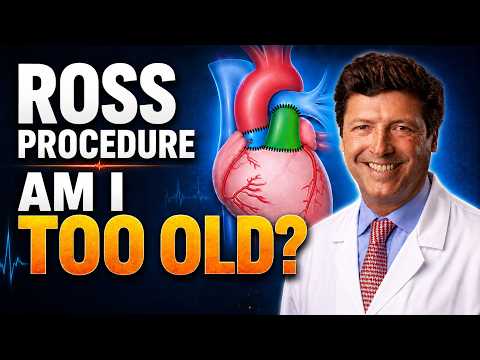

Video available online at:
https://www.youtube.com/watch?v=clf4LHrMX98
Facts About Age and Ross Procedure Candidacy
Here are the key insights shared by Dr. Umana:
First, a quick answer for Lisa. “That is a very good question, Lisa, and I think the short answer is you are a candidate for a Ross Procedure,” said Dr. Umana. “Patients with bicuspid aortic valves and aortic stenosis are wonderful candidates for a Ross Procedure. To fix the ascending aortic aneurysm, we can replace it after replacing the aortic valve with the pulmonic valve.”
Age can be a limiting factor. “Now, regarding age, there are some limitations. What we are seeing is that after 60, it may not be a good idea to do a Ross Procedure because, as we get older, we lose collagen. Our tissues become more rigid, and the same thing happens to the pulmonic valve,” said Dr. Umana. “As a consequence, it lasts less than it should. As a result, my cutoff is 60 years of age. I think patients who are healthy at 55 or 56 should undergo a Ross Procedure, given good heart function and the fact that today’s life expectancy for a 56-year-old is probably 80 years.”
The Ross Procedure is a good solution for younger patients. “We must be able to offer an operation that restores life expectancy in that age group, where we are in a gray zone between a mechanical valve and a bio prosthesis. I think the Ross Procedure fits perfectly in there and should be a one-and-done in terms of a valve replacement for aortic stenosis.”
Thanks Dr. Umana and the University of Miami Health System!
On behalf of all the patients in our community, thank you, Dr. Juan Pablo Umana, for everything you and your team are doing at the University of Miami Health System in Miami, Florida!
Related links:
Keep on tickin,
Adam
P.S. For the deaf and hard-of-hearing members of our patient community, we have provided a written transcript of our interview with Dr. Umana below.
Written by Adam Pick
Patient & Website Founder

Written by Adam Pick - Patient & Website Founder
Adam Pick is a heart valve patient and author of The Patient's Guide To Heart Valve Surgery. In 2006, Adam founded HeartValveSurgery.com to educate and empower patients. This award-winning website has helped over 10 million people fight heart valve disease. Adam has been featured by the American Heart Association and Medical News Today.
Video Transcript:
Adam Pick: Hi, everybody. It's Adam with HeartValveSurgery.com, and we're at the American Association for Thoracic Surgery meeting in Chicago, Illinois. I'm thrilled to be joined by Dr. Juan Pablo Umana, who is the chief of cardiac surgery at University of Miami Health System in Miami, Florida. Dr. Umana, it is great to see you again, and thanks for being with me today.
Dr. Juan Pablo Umana: Thank you for having me, Adam. Pleasure.
Adam Pick: Yeah, so we're here at AATS. A lot of great information and new research is coming out. We're also getting questions from patients from all over the world, and this one is right in your specialty.
It comes from Lisa, and she asks, "I'm a healthy 56-year-old woman. I was diagnosed with moderate bicuspid aortic valve stenosis and a 4.6 ascending aortic aneurysm. How old is too old to have a Ross Procedure, and would a Ross procedure be appropriate for a bicuspid aortic valve and aneurysm patient?"
Dr. Juan Pablo Umana: That is a very good question, Lisa, and I think that the short answer is you are a candidate for a Ross Procedure. Patients with bicuspid aortic valves and stenosis are wonderful candidates for a Ross Procedure. The ascending aortic aneurysm, we can fix by replacing the ascending aorta after we replace the aortic valve with a pulmonic valve.
Now, regarding the age, there are some limitations, and what we're seeing is that after 60 it may not be a good idea to do a Ross Procedure. And the reason is, as we get older, we lose collagen. Our tissues become a little bit more rigid, and the same thing happens to the pulmonic autograft.
And as a consequence, it probably lasts less than it should. My cutoff, as a consequence, is 60 years of age. I think patients that are healthy at 55, 56 should undergo a Ross procedure, all things being equal, given good heart function and the fact that today the life expectancy of a 56-year-old is probably 80 years.
We have to be able to offer an operation that restores life expectancy in that age group where we are in a gray zone between a mechanical valve and a bioprosthesis, and I think the Ross Procedure fits perfectly in there and should be a one and done in terms of a valve replacement for aortic stenosis.
Adam Pick: Wow. Well, as a Ross procedure patient myself, which I had o- almost 20 years ago, I've not needed a reoperation or reintervention. I have not been on anticoagulation (blood thinners like Coumadin). And so Lisa, I hope that helped you learn more. I know it helped me learn more. And Dr. Umana, on behalf of Lisa, all the patients in our community, thanks to you and everything your team are doing at the University of Miami Health System in Miami, Florida.
Thanks for being with me today.
Dr. Juan Pablo Umana: Thanks very much, Adam.
New Patient Posts



Surgeon Spotlight


Dr. Joel Corvera is a world-renowned heart valve surgeon that has performed thousands of heart valve operations.