

Exercise and Heart Valve Disease: Before and After Surgery
Written By: Allison DeMajistre, BSN, RN, CCRN
Medical Expert: Marc Gerdisch, MD, Director of Minimally Invasive Cardiac Surgery, Indiana University Health, Indianapolis, Indiana
Reviewed By: Adam Pick, Patient Advocate, Author & Website Founder
Published: October 21, 2026
Staying active is an important part of a healthy lifestyle. For heart health, the American Heart Association recommends regular moderate-to-intense aerobic exercise and strength training at least twice a week. However, exercise can be more complicated for patients with heart valve disease, so it is important to know what is safe and when to stop.
We regularly receive questions from our community looking for more clarity about exercise. The most recent comes from a patient who asked, "Can you help me understand what I should know about exercise and heart valve disease?" To get a thorough answer, Adam Pick, founder of HeartValveSurgery.com, met with Dr. Marc Gerdisch during a conference at the Endoscopic Cardiac Surgeons’ Club in Northern Kentucky. Dr. Gerdisch is the Director of Minimally Invasive Cardiac Surgery at Indiana University Health in Indianapolis, Indiana. With over two decades of experience, he has performed over 5,000 cardiac surgeries involving heart valve procedures and specializes in complex reoperative surgeries and multi-valve operations.
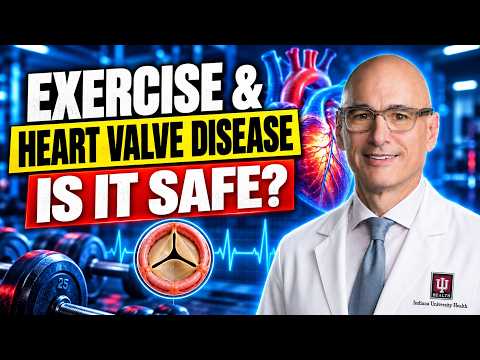

Video available online at:
https://www.youtube.com/watch?v=vSUG7bjSag8
Key Facts About Exercise and Heart Valve Disease
Here are the key insights shared by Dr. Gerdisch:
Patients with mild valve disease don't have exercise restrictions but should always watch for symptoms. "This is a really important question and resurfaces in the literature every five or six years with someone experimenting and evaluating patient response to exercise," said Dr. Gerdisch. "The first thing to be aware of is that for patients with mild valve disease, there really aren't any restrictions." He explained that patients should watch for any symptoms during exercise and follow up with their physician. "Mild valve disease shouldn't prohibit any type of exercise patients want to do. The only caveat is that no matter what a patient's valve pathology is, they should avoid massive straining and lifting more than they should."
Patients with moderate disease fall into two categories: insufficiency and stenosis. "Moderate insufficiency involving the aortic or the mitral valve, and even the tricuspid valve, shouldn't cause much restriction for patients. They should be able to do moderate exercise like riding a bike, swimming, walking, jogging, and resistance training, as long as it's not over the top." Dr. Gerdisch then explained that moderate stenosis may require more attention. "Stress or strain during exercise with moderate stenosis could elicit enough pressure on the heart to change what the heart is experiencing. I think people with moderate aortic valve stenosis should pay attention to their symptoms. If they start getting short of breath, have any chest discomfort, or become dizzy, they should be evaluated by their physician because it might turn out that their moderate stenosis may be more severe than originally thought."
Patients with severe disease need to be more mindful of their exercise. "People who have severe disease, whether it's regurgitation or stenosis, need to take it easy. I think walking, stationary biking, that kind of thing is fine. We can still be more liberal with severe insufficiency than with severe stenosis because with severe stenosis the heart may not have enough blood flow to the heart muscle with too much exercise. So, working out hard would not be a good idea for anyone with severe aortic valve stenosis. Patients should always connect with their healthcare provider for a prescription for the proper level of exercise. They should monitor their symptoms, blood pressure, and even their heart rhythm. We have all these devices available now that can do that."
Staying active before surgery is imperative for a speedy recovery. Dr. Gerdisch explained that heart valve patients should stay active when they do need surgery. He said, "As part of our protocols, we have 'prehab.' We'll often meet with patients a couple of months before surgery and have them exercise during those months leading up to the operation. We want patients to be as fit as possible before surgery. So, incorporating physical activity with valve disease is important. We'll talk about what it's like after surgery also. We've eliminated restrictions so people can essentially go right back to exercising after surgery. We try to make it a little blip in their life and get them back on course."
Enhanced recovery protocol and patient success. "Patients always ask about the restrictions after surgery, and we don't have any. I have a slide that basically tells people they can do things because they don't think they'll be able to right after surgery. I've been doing minimally invasive surgery for 25 years, and a decade ago we were essentially able to get rid of narcotics and let people do whatever they wanted. They could get back to driving and live their lives."
Minimally invasive surgery versus sternotomy yields similar recovery times. "Immediately after a minimally invasive valve operation, our length of stay got so short that sometimes people go home a day or two after surgery." Dr. Gerdisch explained that they realized they could use the same recovery method for patients who needed to have their chest open for surgery and progress toward the same successful results they had with the patients who had minimally invasive surgery. "It doesn't matter which way we do the surgery. The recovery process, the expectations, our methodology, and the medications we use are all exactly the same. We have the same order set for every patient that has heart surgery with us. It's been a bit of a miracle for us because folks can have a sternotomy surgery and drive home if they want to." He said results can vary depending on a patient’s comorbidities at the time of surgery. "I think when you look at the data we published last year, the thing I think is most important is that in the old days, 33 percent of our patients would go from the hospital to some kind of extended care facility like a rehab. Now, that number is down to six percent. So, even though the hospital stay may be only a day or two or three, the important thing is that people want to go home and back to their normal lives, and that's what we've accomplished by improving our recovery methods. I want people to realize that while we are minimally invasive surgeons, we need to offer all patients the full spectrum of recovery that can come with any approach."
There has been an overwhelming success in reducing the need for post-operative narcotic pain medication. "The reduction in the use of pain medication wasn't because we were taking pain medication away," said Dr. Gerdisch. "It's because we were taking pain away. We still had those medications available, but people weren't using them. If we look at our median use of narcotics around the time of surgery, regardless of whether we've gone through a small incision or a larger one, the median use of narcotics in our program is zero." Dr. Gerdisch explained that another factor in pain reduction is managing the sternum and quickly normalizing chest mechanics to get people off the ventilator right away. "Our median time to extubation, or getting the breathing tube out, is zero. Most patients are off the ventilator leaving the operating room, and most don't need any narcotics. They don't go home with them either because they don't need them. That's why I said they can drive because they're not on narcotics and they're not hurting, so they can go ahead and live their lives. In fact, we have videos of people hitting fast pitch three weeks out of surgery. More importantly, though, patients are getting back to the rhythm of their normal lives with the assurance that there's a durable outcome. We try to balance all the components of what happens after the surgery, from the first week to three weeks, three months, and then what happens throughout a patient's life, and give them the optimal, perfect operation in a setting that gets them back to their lives as quickly as possible."
Thanks, Dr. Gerdisch and Indiana University Health!
On behalf of all the patients in our community, thank you, Dr. Marc Gerdisch , for everything you and your team are doing at Indiana University Health in Indianapolis, Indiana.
Related links:
Keep on tickin,
Adam
P.S. For the deaf and hard-of-hearing members of our patient community, we have provided a written transcript of our interview with Dr. Gerdisch below.
Written by Adam Pick
Patient & Website Founder

Written by Adam Pick - Patient & Website Founder
Adam Pick is a heart valve patient and author of The Patient's Guide To Heart Valve Surgery. In 2006, Adam founded HeartValveSurgery.com to educate and empower patients. This award-winning website has helped over 10 million people fight heart valve disease. Adam has been featured by the American Heart Association and Medical News Today.
Video Transcript:
Adam Pick: Hi everybody. It's Adam with HeartValveSurgery.com, and we're at the Endoscopic Cardiac Surgeon's Club in Northern Kentucky. I'm thrilled to be joined by Dr. Mark Gerdisch, who is the chief of cardiac surgery at Franciscan Health in Indianapolis, Indiana. Dr. Gerdisch. We have known each other for over a decade. It is great to see you again. Thanks for being with me today.
Dr. Marc Gerdisch: Thanks, Adam. Pleasure to be here.
Adam Pick: So we're here at this conference learning a lot, and we're also getting questions from patients coming in all over the world. And this one is a question we get from a lot of patients and I'm hoping you can help out. The question is, can you help me understand what I should know about exercise and heart valve disease?
Dr. Marc Gerdisch: This is a really important question and it actually kind of resurfaces in the literature. Every five or six years we see someone kind of experimenting with evaluating patient response to exercise. So super important. I think that the first thing to be aware of is that if you have mild valve disease, there really isn't anything in the way of restrictions.
You should still pay attention to any symptoms. You should have some follow up with your physician, but mild valve disease really shouldn't prohibit you from whatever type of exercise you want to do. Caveat is that no matter what your valve pathology is, you want to avoid like massive straining, pushing hard, kind of, you know, lifting more than you should lift kind of thing, right?
So that's the one caveat that goes across the board, but the rest of it, for mild disease, you can pretty much do what you want. When you get into moderate, then you've got two camps, you've got insufficiency and stenosis. So, depending on the valve to some degree, but moderate insufficiency. With either the aortic or the mitral valve, or let's say the tricuspid valve really shouldn't restrict you much.
You should be able to do at least moderate exercise, certainly riding a bike, swimming, walking, jogging, um, resistance training, that's just not over the top. Those are all going to be fine. With moderate stenosis, for example, moderate stenosis is the aortic valve. With stress, with strain, you can elicit enough pressure and strain on the heart to kind of change what your heart's experiencing.
I think it's important for people who have moderate aortic valve stenosis to be paying attention simply to their symptoms. If you're starting to get short of breath, if you're having any chest discomfort, a little bit of dizziness, all of that needs to be brings you back to evaluation with your physician because it might turn out that the moderate is actually a little bit more than moderate.
People who have severe disease, whether it's regurgitation or stenosis, there, we have to kind of take it easy. I think still walking some biking, maybe stationary bike, that kind of thing is fine. Certainly, you can be a little bit more liberal with insufficiency, with severe insufficiency, then you can with severe stenosis, because with severe stenosis, you could literally cause your heart to have not enough blood flow to the heart muscle.
So aortic valve stenosis, that's severe. So working out hard would not be a great idea. Always connect with your healthcare provider to get some type of prescription. For your level of exercise, monitor your own symptoms, perhaps even your heart rhythm. We have all these devices that'll do that for you.
Monitor your own blood pressure, pay attention to things that we should all be paying attention to anyway. But, certainly you can continue to be active and it's important to be active because when you do have your operation, you want to be as fit as possible. We actually, as part of our protocols, we have “prehab”.
Which is basically when we meet our patients before surgery, and often it's not going be for a couple of months, if they're going to have surgery, we have them exercising. And so we want them as fit as possible before they have surgery. So it's important that people incorporate that. And it also helps your heart be healthier as well.
So incorporating physical activity while you have valve disease is important. And then tomorrow we're going to talk about what it's like after surgery, which. As you know, we've eliminated restrictions essentially, so people can go right back to exercising after surgery. So we try to make it just a little blip in their life and get them back on course.
Adam Pick: :Let's talk about that. You're giving a talk all about your enhanced recovery protocol for patients, and we've seen some of the stories of your patients successes. Can you share a little bit about some of the activities that these folks are getting back to very quickly? Yeah. So, uh, one of the.
Slides that I incorporated for the talk tomorrow because people are always like, well, what are your restrictions? And we just don't have any. So I have a slide that basically tells people that they can do things right because people don't think they can. And one of the interesting things that we experienced was, you know, I've been doing minimally invasive valve surgery for 25 years and, uh, a decade ago, we essentially were able to get rid of narcotics and let people do whatever they wanted and go back to driving and live their lives.
Immediately after a minimally invasive valve operation, we also, our length of stay got so short that sometimes people go home day two after hard valve surgery. So, but then we realized with the method that we were using to manage the sternum and people who needed to have their chest open for surgery, that we could progress toward the same results and we did.
It doesn't matter which way we do your surgery. The recovery process, the expectations, our methodology, the medications we use are all exactly the same. We have the same order set for every patient that has heart surgery with us. This has been really a, this has been a little bit of a miracle for us because folks can have sternotomy surgery and drive home if they want to.
I mean, we literally have that happen. People get there driving their car and drive home and. You know, for different people it'd be different depending on their, their comorbidities at the time of surgery. But I think when you look at all of our data, and we published this last year, the, the thing that I think is most important is that in the old days, a third of our patients would go from the hospital to some kind of extended care facility, rehab something.
So this all comers, redos, ery old people, very young people. Everybody is in that pod. And we went from one third down to 6%. So that for me is the most telling thing. You know, hospitals stay great, they're not in the hospital very long. People are in the hospital for all kinds of different things for a day or two, or three or five, whatever.
But most importantly, people want to go home and they want to go back to their normal lives. And that's really what we accomplish by doing that. And that's really what I'm going to try to drive home. For everybody tomorrow that while we are minimally invasive surgeons, we have to be able to offer people the, uh, full spectrum of recovery that can come with any approach.
Adam Pick the data I'm waiting to hear from you about this question is, you talked about the medications that you use during the process for your patients. What about the medications that you don't use? For example, for example, pain management, I think you've been on a crusade to lower the amount of opioid use. Can you talk about that?
Dr. Marc Gerdisch: So, and, and it's interesting because the, uh, the reduction in use of pain medication wasn't because we were taking pain medication away. It's because we were taking pain away. So we still had it available but people weren't using it. So, uh, if we look at our median use of narcotics around the time of surgery, and it doesn't matter which approach.
Whether I'm going through a little incision here or a larger incision here, the median use of narcotics in our program is zero. And the other thing, we recognize that the mechanics, because of the way we manage the sternum, and obviously when we do minimally invasive surgery, the mechanics of the chest were normalized so quickly that we could get people off the ventilator right away.
So our median time to extubation taking the tube, the breathing tube out of the mouth is zero. So vast majority of patients are off the ventilator leaving the operating room. Vast majority of patients don't need any narcotics and they don't go home with them either because they don't need them. That's why I said they can drive because they're not on narcotics and they're not hurting so they can go ahead and live their lives.
So yeah, we do have some, as you know, and just so people could see, we have videos of, you know, people hitting fast pitch, you know, three weeks out from surgery. But I think more importantly, just getting back to the rhythm of their normal lives and also having the assuredness that there's a durable outcome like that.
So. There's what happens in that first week? What happens in the three weeks? What happens in the three months, and then what happens in the rest of your life? And we try to balance all of those components and give people the optimal, perfect operation in a setting that gets them back to their lives as quickly as possible.
Adam Pick: Well, on behalf of your patients, on behalf of patients all over the world. In particular, Mr. Derloshon, who is just getting ready to run a half marathon, will put up a picture of him. He was a redo. He's been an inspiration to our community. That's lovely. I want to thank you and your extraordinary team, Dr. Gerdisch at Franciscan Health for everything you're doing on behalf of the patients.
Dr. Marc Gerdisch: It's our privilege.
New Patient Posts



Heart Hospital Map

Search for heart hospitals that specialize in heart valve treatment.
The Patient's Guide
This book has helped over 47,000 patients and caregivers from diagnosis to recovery.