“Pictures Of Heart Valve Disease?” Asks Ray
Written By: Adam Pick, Patient Advocate, Author & Website Founder
Page Last Updated: June 12, 2025
Ray just emailed me a great question about heart valve disease.
He writes, “Adam – Try this one on for size… I’m 57 and newly diagnosed with severe stenosis in my aortic valve. The docs think I need surgery soon. I can’t believe it. I feel fine. No real symptoms. But, the echo shows my heart is already dilated somewhat. Even though the cardiologist told me what is wrong… I want to see what is wrong. Do you have any pictures of heart valve disease? Thanks, Ray”
Like Ray, I experienced a very similar thought upon diagnosis, “What does a diseased heart valve look like?” That said, please find several pictures below to help Ray (and perhaps you) better understand the visual anatomy of several different types of valve disease.
First, however, I thought you might like to see what a normal heart valve looks like for comparison. Here are two pictures of a normal aortic heart valve.


Below is a picture of a calcified bicuspid aortic valve. The valve cusps are rigid, distorted and deformed. And, the bicuspid aortic valve that is severely calcified. (So you know, this was my diagnosis prior to double heart valve surgery.)

In this picture of mitral valve prolapse, you can see how the two leaflets do not seal properly causing blood to leak backwards.
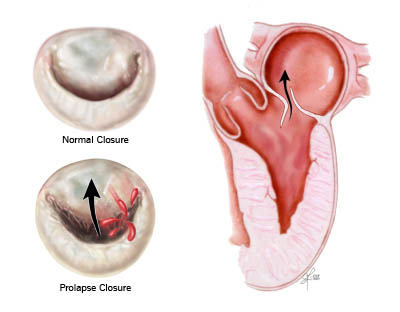
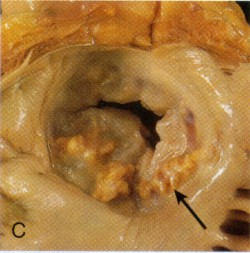
Finally, if you were wondering, “Does calcification of the leaflets impact the mitral valve?”
The answer to that is yes. Here is picture of a mitral valve with severe calcification on the leaflets and annulus.
I hope these pictures help you better visualize some of the various forms of heart valve disease. If you have any additional pictures to share, please let me know!
Related Links:
- Heart Valve Calcification: 8 Important Facts to Know
- Mitral Annular Calcification: Why Is It Difficult to Treat?
Keep on tickin!
Adam
Written by Adam Pick
- Patient & Website Founder

|
Chuck Harris says on August 3rd, 2009 at 1:33 pm |
|
When I was diagnosed w/ aortic stenosis, my cardiologist tolde that one of the hard choices was to decide when to do the surgery because most patients feel fine for a good bit of the time. But it never. Gets better only worse. In my case, I had a spell at work and that was the kicker. They said it was time. I had my AVR this past feb. |
 |
|
Jean Karloski says on August 3rd, 2009 at 8:18 pm |
|
Ray, I am 58 and had my routine physical. the doctor heard a significant murmur and after testing etc was told I needed an aortic valve replacement. I felt fine….and, in fact, had worked 70 hours that week. No shortness of breath….no nothing. So it was very hard to think that I needed open heart surgery. It took me two months just to get it straight in my mind. How can I do that big of a surgery and feel so good? I am 7 months out now….did very well, recovery went well and I am glad it is behind me. It was not as bad as I expected. I thought I was crazy though because if I really needed surgery why would I feel fine? This is a very common statement coming from patients. My cardiologist told me “It’s time” Everything was changing in my heart. Hope this helps, |
|
|
Mary Ferraro says on August 4th, 2009 at 5:23 pm |
|
I felt great in Nov. when I got the news it was time to fix my heart valve. Due to a complicated series of events I couldn’t be operated on until the following October. I continued to feel great all winter and spring but by the summer I was tiring out and by that following October there were times I was breathing between words and had to sit down for long phone conversations . . . I even fell over 3x running up the stairs at work. My point is to get a second opinion and do not wait. As blood in the heart was forced to swirl around over and over retracing its route while trying to get out, I was increasing my risk that a clot could form and either escape to cause a heart attack or a stroke. Also, as the valve is not doing its job correctly, the heart muscle must work extra hard and as any muscle works harder it gets thicker. This hypertrophy or dilation is not good either. I needed to get my valve fixed while my heart was still in good enough shape to recover in a reasonable fashion from the surgery. You can do this. Read Adam’s book and find the best surgeon. |
|
|
Joe says on August 4th, 2009 at 7:59 pm |
|
I was diagnosed around age 50 with moderate aortic stenosis after having a slight murmur and was told valve replacement was inevitable. By last year at age 55 I went from moderate to severe and I was told replacement was needed soon. Living in northern Ohio, I researched Cleveland Clinic’s website. Wow, what a great site to learn about heart desease! They even have actual videos of surgeries. Wheather you’re near Cleveland Clinic or not, visit their website to get the basics as well as details of all areas of valve desease and replacement. It is extremely informative… http://my.clevelandclinic.org/default.aspx |
|