
Mitral Valve Ring Leakage and Durability with Dr. Patrick McCarthy
Written By: Allison DeMajistre, BSN, RN, CCRN
Medical Expert: Patrick McCarthy, MD, Executive Director, Bluhm Cardiovascular Institute, Northwestern Medicine, Chicago, Illinois
Medically Reviewed By: Adam Pick, Patient Advocate, Author & Website Founder
Published: August 13, 2026
Open heart surgery for a leaking mitral valve is stressful. Perhaps the only thing that rivals that stress is learning that the repaired valve is showing leakage after routine testing. We regularly get patient questions about this situation, and it’s understandable that they want more information about the leakage and its implications.
The most recent question we received is from Madeline, who asked, “My open-heart surgery was in 2015. Dr. Patrick McCarthy repaired my mitral valve by placing a ring around the valve to stop the leak. In my reports, it is indicated that there is now a small leak in the valve. Will this leak become larger, and how long does the ring last?”
We were fortunate enough to meet with Dr. Patrick McCarthy, Madeline’s surgeon, to answer her question. Dr. McCarthy is the Executive Director of the Bluhm Cardiovascular Institute at Northwestern Medicine in Chicago, Illinois. Dr. McCarthy is also the inventor of the new TransForm McCarthy Mitral Valve Ring.
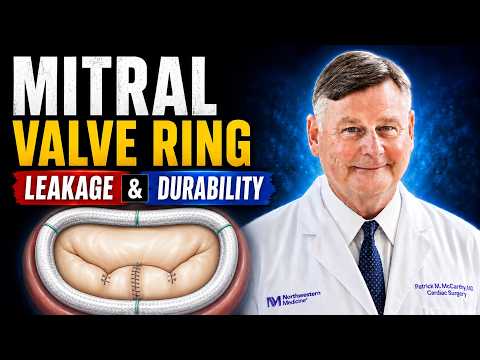

Video available online at:
https://www.youtube.com/watch?v=5wrhRLsmER8
Facts About Mitral Valve Ring Leakage and Durability
Here are the key insights shared by Dr. McCarthy:
Reassurance of mitral valve ring durability. Dr. McCarthy said, “So, the ring lasts forever, and they’re kind of inert, and so nothing actually happens. They don’t degenerate or get worse like tissue valves, so the ring is fine.”
Assessing the level of leakage. Dr. McCarthy explained that they assess leakage on a scale from 1 to 4. “Four is a severe leak; one is mild, and zero is none,” he said. “A small leak may be one out of four, and if we walked around today with an echocardiogram probe, we could find a lot of people who may have one out of four. So, we keep an eye on all repairs we do, but one out of four is nothing too exciting, so Madeline should be reassured by that.”
Is annual surveillance with an echocardiogram advisable? “We recommend everyone who’s had a valve repair to have a cardiologist and to follow up with them. The cardiologist will listen for a heart murmur with a stethoscope and periodically get an echocardiogram,” said Dr. McCarthy.
Thanks Dr. McCarthy and Northwestern Medicine!
On behalf of all the patients in our community, thank you Dr. Patrick McCarthy for everything you and your team are doing at Northwestern Medicine in Chicago, Illinois!
Related links:
Keep on tickin,
Adam
P.S. For the deaf and hard-of-hearing members of our patient community, we have provided a written transcript of our interview with Dr. McCarthy below.
Written by Adam Pick
Patient & Website Founder

Written by Adam Pick - Patient & Website Founder
Adam Pick is a heart valve patient and author of The Patient's Guide To Heart Valve Surgery. In 2006, Adam founded HeartValveSurgery.com to educate and empower patients. This award-winning website has helped over 10 million people fight heart valve disease. Adam has been featured by the American Heart Association and Medical News Today.
Video Transcript:
Adam Pick: Hi, everybody. It's Adam with HeartValveSurgery.com, and we're at the American Association for Thoracic Surgery Conference in Chicago, Illinois. I'm thrilled to be joined by Dr. Patrick McCarthy, who's the executive director of the Bluhm Cardiovascular Institute at Northwestern Medicine in Chicago, Illinois.
Dr. Patrick McCarthy, it is great to see you again, and thanks for being with me today. All right.
Dr. Patrick McCarthy: Thanks, Adam.
Adam Pick: Yeah, so we're here at AATS. We're seeing lots of great presentations. New research is coming out. We're also getting questions from patients all over the world, and this question is coming in from your patient.
It's from Madeline, and she asks, "Hi, Adam. My open heart surgery was in 2015. Dr. Patrick McCarthy repaired my mitral valve by placing a ring around the valve to stop the leak. In my reports, it is indicated that there is now a small leak in the valve. My question: Will this leak become larger, and how long does the ring last?"
Dr. Patrick McCarthy: So the ring lasts forever, and they're kind of inert, and so nothing actually happens. They don't degenerate or get worse like tissue valves. People think about pig or cow valves. Uh, so the ring is fine. Um, on that scale up to four, where four is the worst, a severe leak, and one is mild, zero of course is none.
So a small leak may be a one out of four, and if we walked around in here today with an echo probe, we could find a lot of people that maybe have a one out of four. And so, you know, we keep an eye on all, uh, repairs that we do. So a one out of four is nothing too exciting, and, and it doesn't mean very much, so should be reassured by that.
Adam Pick: Great. And so for someone like Madeline, would you encourage her to continue doing annual surveillance with an echocardiogram?
Dr. Patrick McCarthy: So anybody that's had a valve repair, we recommend they have a cardiologist home, and they're following up with them. They'll also always listen for heart murmur with a stethoscope, and then periodically maybe getting an echo.
Adam Pick: Fantastic. Well, Madeline, I hope that helped you, and Dr. McCarthy, thanks to you and your team at Northwestern Medicine Thanks for everything you're doing.
Dr. Patrick McCarthy: Thank you, Adam.
Upcoming Surgeries



The Patient's Guide
This book has helped over 47,000 patients and caregivers from diagnosis to recovery.
Surgeon Spotlight


Dr. Joel Corvera is a world-renowned heart valve surgeon that has performed thousands of heart valve operations.