

Study: How Gender Impacts Enlarged Hearts After Valve Replacement
Page Last Updated: May 10, 2025
In the past, we've talked about the risks of valvular disorders and enlarged hearts. Recently, a study was released which further examined whether or not dilated hearts return to normal size after heart valve surgery. Interestingly, the study considered this post-operative objective from a male and female perspective.
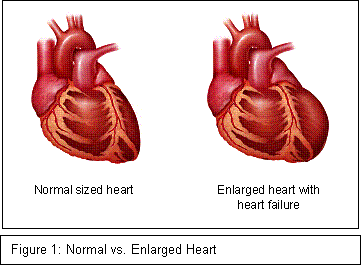
According to the study, published in Circulation, genetic differences may explain why enlarged hearts shrink faster in women than in men after aortic valve replacement. If you were unaware, heart enlargement (also known as dilation) can occur when the aortic valve becomes narrowed due to aortic stenosis.
This disease results in limited blood flow through the aortic valve. An aortic valve replacement with a mechanical, tissue or human donor valve treats this problem.
The German researchers said their study of 53 female (average age 72) and 39 male (average age 67) patients found that heart enlargement regressed faster in the women than in the men after aortic valve replacement. This may be because of genetic differences that cause men's hearts to develop more fibrous tissue after surgery.
Left ventricle enlargement was more common in women than in men before aortic valve replacement. After surgery, the prevalence of this condition fell more in women (86 percent to 45 percent) than in men (56 percent to 36 percent).
Dr. Vera Regitz-Zagrosek, director of the Institute of Gender in Medicine at Charite University of Medicine in Berlin, and co-author of the study, said, "We show for the first time that elderly women and men differ in their gene expression related to fibrous heart tissue. We hypothesize that women with aortic stenosis develop a different form of the same disorder."

According to the researchers, the findings above need to be replicated in larger trials (that are already under way), but may lead to new ways to slow the increase of fibrous heart tissue after aortic stenosis. Pretty interesting, right?
Related Link:
Keep on tickin!
Adam
Written by Adam Pick
Patient & Website Founder

Written by Adam Pick - Patient & Website Founder
Adam Pick is a heart valve patient and author of The Patient's Guide To Heart Valve Surgery. In 2006, Adam founded HeartValveSurgery.com to educate and empower patients. This award-winning website has helped over 10 million people fight heart valve disease. Adam has been featured by the American Heart Association and Medical News Today.
Comments





Adam's Newest Blogs


New Community Posts
Blog Categories
- Adam's Updates
- Aneurysms
- Aortic Stenosis
- Aortic Valve Repair
- Aortic Valve Replacement
- Atrial Fibrillation
- Before Surgery
- Bicuspid Aortic Valve
- Heart Valve Replacement
- Medical Technology
- Mitral Regurgitation
- Mitral Valve Repair
- Patient Stories
- Pulmonary Valve
- Recovery
- Ross Procedure
- Surgeons & Hospitals
- Tricuspid Valve
Blog Categories
- Adam's Updates
- Aneurysms
- Aortic Stenosis
- Aortic Valve Repair
- Aortic Valve Replacement
- Atrial Fibrillation
- Before Surgery
- Bicuspid Aortic Valve
- Heart Valve Replacement
- Medical Technology
- Mitral Regurgitation
- Mitral Valve Repair
- Patient Stories
- Pulmonary Valve
- Recovery
- Ross Procedure
- Surgeons & Hospitals
- Tricuspid Valve
Blog Categories
- Adam's Updates
- Aneurysms
- Aortic Stenosis
- Aortic Valve Repair
- Aortic Valve Replacement
- Atrial Fibrillation
- Before Surgery
- Bicuspid Aortic Valve
- Heart Valve Replacement
- Medical Technology
- Mitral Regurgitation
- Mitral Valve Repair
- Patient Stories
- Pulmonary Valve
- Recovery
- Ross Procedure
- Surgeons & Hospitals
- Tricuspid Valve
Heart Hospital Map

Search for heart hospitals that specialize in heart valve treatment.
Adam's Video Library

Learn about heart valve surgery and patient success stories at Adam's video library.
New Posts From Our Community

J Alexander Lassally from
Boston
Hi friends, I've been away and just wanted to say hello....
Meet J Alexander
Adam Pick from
Torrance, California
Hey Everybody! In case you missed it... Yesterday, we had an...
Meet Adam
Rose Madura from
Dayton, Ohio
Adam, thank you so much for the informative webinar yesterday. I...
Meet RoseNewest Community Post
J Alexander Lassally from
Boston
Hi friends, I've been away and just wanted to say hello....
Meet J Alexander
Find Heart Valve Surgeons
Search 1,500 patient-recommended surgeons
Heart Hospital Map
Search for heart hospitals that specialize in heart valve treatment.
Adam's Video Library
Learn about heart valve surgery and patient success stories at Adam's video library.