Leaking Heart Valve Symptoms, Causes & Problems
As I personally learned when I was diagnosed with a leaky aortic valve, several different heart valve diseases, infections and disorders can lead to patient symptoms including shortness of breath and chest pain.
Patients should know that the main cause of a 'leaking heart valve' results from an abnormal anatomical structure that enables blood to flow, or leak, in the wrong direction. The medical term for this is valvular regurgitation.
To help you learn about leaking heart valves, I recently filmed this video with Dr. Kevin Accola, a leading cardiac surgeon at AdventHealth Cardiovascular Institute (formerly Florida Hospital), who specializes in valve therapy.
The diagram below shows how and why a leaking valve results from a condition known as mitral valve prolapse, the most common heart valve disorder.
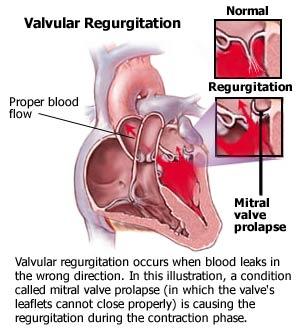
Regurgitation can negatively impact the flow of blood across each of your four heart valves - the aortic valve, the pulmonary valve, the mitral valve and the tricuspid valve. However, the most common forms of regurgitation are:
- Mitral regurgitation in which blood leaks backward from the left ventricle to the left atrium.
- Aortic regurgitation in which blood leaks backward from the aorta to the left ventricle.
Often, the anatomical issue which causes a leaky heart valve is related to the tissue leaflets (e.g. mitral leaflets) or the annulus (e.g. mitral annulus) of the valve.
Symptoms & Asymptomatic Patients
The most common symptoms of leaking heart valves are:
- Shortness of breath, especially with exertion or when you lie down
- Fatigue, especially during times of increased activity
- Cough, especially at night or when lying down
- Heart palpitations — sensations of a rapid, fluttering heartbeat
- Swollen feet or ankles
- Heart murmur
- Excessive urination
- Chest pain (angina) or tightness
- Feeling faint or fainting with exertion
- Dizziness
However, it is critical to note that symptoms do not always appear, or manifest, simultaneously for a patient. Many patients can be asymptomatic even though they suffer from mild, moderate, or even severe heart valve disease.
Potential Problems With Leaking Heart Valves
Leaky heart valves force the cardiac muscle to "work harder" as the heart re-pumps blood through a valve. Over time, this can lead to an enlarged heart, also known as a dilated heart or cardiomegaly. The long-term effects of cardiomegaly are:
- Fluid in the lungs
- Abnormal heart rhythms
- Edema
- Blood clots
- Congestive heart failure
My Personal Story With Leaky Valve Symptoms?
I had a severely leaking aortic valve when I learned that I needed heart valve replacement surgery. So you know, I only had one symptom which led me to seek medical help and surgical treatment. That said, I highly encourage you to visit your doctor if you are experiencing any of the symptoms identified above or you have been previously diagnosed with valvular regurgitation or a heart murmur.
So you know, some heart valve diseases can be identified by listening to your heart with a stethoscope. This is usually the first step in diagnosing heart valve disease or a potential leak in the valve. Another test to help identify leaky heart valves is an echocardiogram.
As for me, it's been 15 years since my leaky valve was fixed during heart valve replacement surgery. I'm happy to report that I'm doing great! After surgery, I've gone on to get married, have a child and live a very active lifestyle that includes hiking, swimming, running, biking and surfing. If I can do it... You can too!!!
Additional Resources For Leaking Heart Valves
To help you learn more about leaking heart valves, here are additional resources to educate and empower you:
- Echocardiogram Use for Leaky Heart Valve Diagnosis
- Mitral Valve Repair for Leaking Valves Restores Normal Life Expectancy
- New MitraClip is a "Game Changer" for Patients With Leaky Heart Valves
- Heart Valve Surgery Innovation: Robotic Surgery Evolves for Leaking Mitral Valves
- Aortic Valve Repair: A New Phenomena for Leaking Aortic Valves?
- Free Educational eBooks: Download 7 Patient eBooks Here
Page last updated: September 17, 2020
Written by Adam Pick
- Patient & Website Founder