

Can A Heart Valve Leak After Mitral Valve Repair?
Written By: Allison DeMajistre, BSN, RN, CCRN
Medical Expert: Marc Gerdisch, MD, Indiana University Health
Reviewed By: Adam Pick, Patient Advocate, Author & Website Founder
Published: October 29, 2026
When patients undergo significant surgery, such as a mitral valve repair, the assumption is often that everything will be fixed and they won’t experience any other problems with the valve. Those expectations are understandable given what they go through before, during, and after surgery. But how perfect should they believe their valve will be, and what is the likelihood that the repair will thoroughly fix the regurgitation?
We received a patient question on this topic from Russ, who asked, “Is it common that patients have regurgitation after a mitral valve repair, and is that a concern for patients?” To answer Russ’s question, we met with Dr. Marc Gerdisch, the Director of Minimally Invasive Cardiac Surgery at Indiana University Health in Indianapolis, Indiana. Dr. Gerdisch has performed more than 5,000 heart valve surgeries and is always a valuable resource for gaining insightful information for patients in our community.
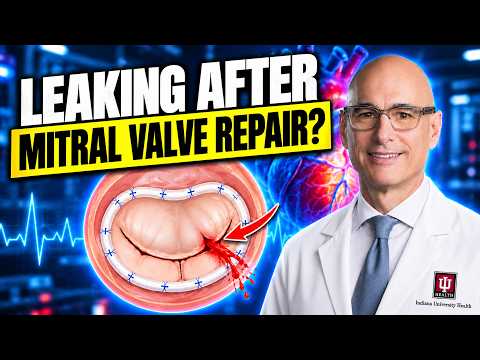

Video available online at:
https://www.youtube.com/watch?v=twlh8sifLjQ
Is Regurgitation Common After Mitral Valve Repair?
Here are the key insights shared by Dr. Gerdisch:
The answer depends on several different factors. “Very good question, as usual,” said Dr. Gerdisch. “Let me put it into perspective. It’s a little dependent on the complexity of the repair, which part of the valve is treated, and which surgeon did the operation.”
What the literature reveals about the statistics. “If we look at the literature very broadly, about five percent of people will have mild insufficiency of a well repaired valve at the end of the operation,” explained Dr. Gerdisch. “If we look at those patients, the five percent that have mild insufficiency, it’s true that if we follow them for a decade, they are more likely to progress to moderate. It would be on the order of those five percent, probably to have a 15 to 20 percent chance of progressing to more moderate regurgitation over ten years. In people who have no regurgitation, about five percent of those patients will see progression in their insufficiency. Now, for both groups, the likelihood of undergoing another operation is actually quite low. And for those who experience moderate regurgitation, it’s only about 15 percent of those patients who will require another operation.
Valve structure is often the most significant factor. Dr. Gerdisch said, “Overall, it has to do with the structure of the valve. There are certain inherent properties of the valve that influence its durability, and these have to do with how well the valve is repaired. Some of the things we argue about at these meetings are how to repair a valve, and we all have different approaches and things that we think are important tactics. At the end of the day, though, we’re trying to achieve the best structure we can with the best mobility of the leaflets and the best opportunity for the patient to do well.
Regurgitation directly after repair may mean trouble. “For the surgeons who do a lot of mitral valve repair, we essentially all want to leave the operating room with no insufficiency. Occasionally, we may have a little bit, and then we focus on that, and we watch it not progress. If someone leaves the operating room with moderate insufficiency, they are potentially in more trouble. I would say their likelihood of moving on to another operation or having to deal with that as a problem, and others going from moderate to severe, is probably in the order of 30 to 35 percent.
Thanks, Dr. Gerdisch and Indiana University Health!
On behalf of all the patients in our community, thank you, Dr. Marc Gerdisch, for everything you and your team are doing at Indiana University Health in Indianapolis, Indiana!
Related links:
Keep on tickin,
Adam
P.S. For the deaf and hard-of-hearing members of our patient community, we have provided a written transcript of our interview with Dr. Gerdisch below.
Written by Adam Pick
Patient & Website Founder

Written by Adam Pick - Patient & Website Founder
Adam Pick is a heart valve patient and author of The Patient's Guide To Heart Valve Surgery. In 2006, Adam founded HeartValveSurgery.com to educate and empower patients. This award-winning website has helped over 10 million people fight heart valve disease. Adam has been featured by the American Heart Association and Medical News Today.
Video Transcript:
Adam Pick: Hi everybody. It's Adam with HeartValveSurgery.com and we're at the Endoscopic Cardiac Surgeon's Club in Northern Kentucky. I'm thrilled to be joined by Dr. Mark Gerdisch, who is the Director of Minimally Invasive Cardiac Surgery at Indiana University Health in Indianapolis, Indiana. Dr. Gerdisch, it is great to see you again.
Dr. Marc Gerdisch: Always a pleasure, Adam. Thank you.
Adam Pick: Thanks for being with me today. We're here at the conference. Excellent information coming out here, research. We're seeing live operations, and we are also getting questions from patients coming in for you from all over the world.
This first one comes in from Russ and he asks, “Is it common that patients have regurgitation after a mitral valve repair? And is that a concern for patients?”
Dr. Marc Gerdisch: So, very good question as usual and common is kind of a, is kind of a big word for, for something. So, to think that something would be common would be you would think that as a problem, that you'd have a leak that would be common.
So let me just kind of put it into perspective with respect to, first of all, it's a little bit dependent on the complexity of the repair. It's dependent on which part of the valve is treated and it's dependent on who the surgeon is. But if we look at the literature very broadly, about 5% of people will have mild insufficiency of a well repaired valve, uh, at the end of the operation.
And if we look at those patients, the 5% that have mild insufficiency, it's true that if we follow them for a decade. They're more likely to progress to moderate, and it would be on the order of those 5%, probably have about a 15 to 20% chance over 10 years of going to more regurgitation to moderate.
I'm going to come back to that because it's important. I people who have no regurgitation, it's about 5% of those patients will see progression in their insufficiency. Now of both of those groups, the likelihood of going on to another operation is actually quite low. And for those who go to moderate, it's only about 15% of those patients go on to another operation.
People who are start out with none and go to mild, it's about 5%. So, you can see where I'm going with this. Overall, it has to do with the structure of the valve. There are certain inherent. Properties of the valve that will influence its durability, and that has to do with how well the valve is repaired.
Some of the things we argue about at these meetings are how to repair a valve. And we all have different approaches and things that we think are important tactics, but at the end of the day we're trying to achieve the best structure we can with the best mobility of the leaflets and the best opportunity for the patient to do well.
And sometimes people have to make a few minor compromises. Now I think that if we look at people who do a lot of mitral valve repair, essentially all of us leave the operating room with no insufficiency, occasionally just a little bit, and then we kind of focus on that and we watch it not progress.
If somebody leaves the operating room with moderate insufficiency, they are potentially in more trouble. I would say their, their likelihood of them moving on to another operation or having to deal with that as a problem and others going from moderate to severe is probably on the order of 30 or 35%.
Adam Pick: Russ, I hope that helped you. I know it helped me, and Dr. Gerdisch has always, thanks for everything that you and your team are doing at Indiana University Health in Indianapolis, Indiana. Thanks so much for being with me today.
Dr. Marc Gerdisch: Thanks, Adam.
Upcoming Surgeries