
Heart Failure and Heart Valve Disease: Early Detection and Life Expectancy
Written By: Allison DeMajistre, BSN, RN, CCRN
Medical Expert: Laura DiChiacchio, MD, Cardiac Surgeon, Cedars-Sinai, Los Angeles, California
Reviewed By: Adam Pick, Patient Advocate, Author & Website Founder
Published: August 19, 2026
It is essential for patients with heart valve disease to understand the facts about heart failure and how it relates to valvular problems like aortic stenosis and mitral regurgitation. Whether heart failure develops along with valve disease or not, once patients begin showing signs of either problem, prompt treatment is imperative to avoid the risk of irreversible heart damage.
To better understand heart failure, valve disease, and the overall outcomes, we spoke with Dr. Laura DiChiacchio, a leading cardiac surgeon at Cedars-Sinai Medical Center in Los Angeles, California. Dr. DiChiacchio provided several insightful facts about the importance of early detection and treatment to increase the likelihood of restoring normal life expectancy.
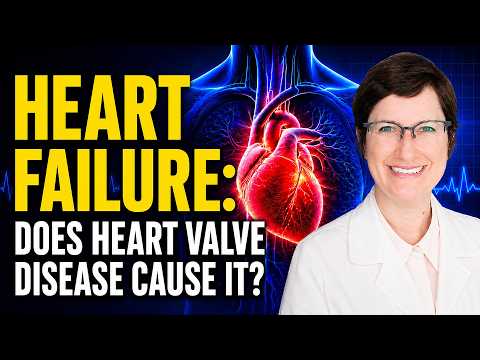

Video available online at:
https://www.youtube.com/watch?v=HCijWSMDLRE
Key Learnings About Valve Disease, Heart Failure and Life Expectancy
Here are the important insights shared by Dr. DiChiacchio:
Heart failure and valve disease are strongly related. “Valvular disease can lead to heart failure when it’s missed or when it’s not treated appropriately,” said Dr. DiChiacchio. “Additionally, heart failure can exacerbate valvular disease.” Dr. DiChiacchio explained that a poorly functioning or non-functioning valve can lead some patients into heart failure.
Early detection and treatment are imperative. “As the heart muscle weakens and begins to fail, the valvular disease gets worse and the patient feels sicker,” said Dr. DiChiacchio. “So, there is a lot of emphasis now on early detection and treatment.” She explained that treatment could involve medical therapy or possibly minimally invasive options like transcatheter approaches to treat the valve disease. It could also mean surgery. “It’s very important to see the heart doctor early to get the valve problem under control, avoid developing heart failure and to stop that spiral before it starts making the patient sick.”
Will treatment restore normal life expectancy? “Absolutely. Once valvular disease is treated appropriately and the development of heart failure is prevented, that expected lifespan is restored. That’s why it’s so important to catch this early.”
Thanks Dr. DiChiacchio and Cedars-Sinai Medical Center!
On behalf of all the patients in our community, thank you, Dr. Laura DiChiaccio, for everything you and your team are doing at Cedars-Sinai Medical Center in Los Angeles, California!
Related links:
Keep on tickin,
Adam
P.S. For the deaf and hard-of-hearing members of our patient community, we have provided a written transcript of our interview with Dr. DiChiaccio below.
Written by Adam Pick
Patient & Website Founder

Written by Adam Pick - Patient & Website Founder
Adam Pick is a heart valve patient and author of The Patient's Guide To Heart Valve Surgery. In 2006, Adam founded HeartValveSurgery.com to educate and empower patients. This award-winning website has helped over 10 million people fight heart valve disease. Adam has been featured by the American Heart Association and Medical News Today.
Video Transcript:
Adam Pick: Hi everybody. It's Adam with HeartValveSurgery.com, and we're in Los Angeles, California at Cedar-Sinai Medical Center. I'm thrilled to be joined by Dr. Laura DiChiacchio, who is a leading cardiac surgeon. Dr. DiChiacchio, it is great to see you and thanks so much for being here today. We get a lot of questions from patients in our community. About heart failure and valve disease. What's the latest thinking and the research about these two related cardiac conditions? And what should they know about it?
Dr. Laura DiChiacchio: Great question. So, valvular disease can lead to heart failure when it's missed or when it's not treated appropriately. In addition, heart failure can exacerbate valvular disease, and so sometimes patients can enter a spiral where a non-functioning valve or not perfectly functioning valve leads to heart failure.
And as the heart begins to weaken, that muscle weakens and fails. The valvular disease gets worse and the patient feels sicker. So there's a lot of emphasis now on early detection and early treatment. It doesn't necessarily mean surgery. It might mean medical therapy. It might mean minimally invasive options like transcatheter approaches to treating valvular disease, or it might mean surgery. But, the earlier you get in and get seen and get that valve problem under control, the more your chances are that you can either avoid developing heart failure or you can stop that spiral before it really starts to make you sick.
Adam Pick: Dr. DiChiacchio, a follow up question is all about normal life expectancy. Given the spiral and you and your team do a great job with that intervention if needed. Can the patient hope to live or expect to live a normal life?
Dr. Laura DiChiacchio: Absolutely. Once valvular disease is appropriately treated and the development of heart failure is prevented, that expected lifespan is restored. That's why it's so important to catch this early.
Adam Pick: Great. Well, on behalf of the patients in our community, people over the world, thanks to you for everything you're doing. Thank you here at Cedars-Sinai. Thanks for being with me today.
Dr. Laura DiChiacchio: Thank you.
Upcoming Surgeries


The Patient's Guide
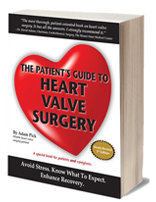
This book has helped over 47,000 patients and caregivers from diagnosis to recovery.