
Aortic Dissection Risks: What Bicuspid Valve Patients Should Know
Written By: Allison DeMajistre, BSN, RN, CCRN
Medical Expert: Christopher Mehta, MD, Director of Bicuspid Aortic Valve Program and Aortic Dissection Program, Bluhm Cardiovascular Institute, Northwestern Medicine, Chicago, Illinois
Reviewed By: Adam Pick, Patient Advocate, Author & Website Founder
Published: July 17, 2026
Aortic aneurysms are often called a ‘silent killer’ because they typically show no symptoms and are frequently only discovered at the time of dissection. For patients, knowing they have an aortic aneurysm can feel like living with a ‘ticking time bomb’ in their chest. Even though surgeons usually recommend monitoring until the aneurysm grows to 5 centimeters in diameter—when intervention is needed—these periodic check-ups often do little to reduce the anxiety of living with this condition.
We received an excellent patient question on this topic from Cindy, who asked, “My husband has a bicuspid aortic valve with moderate regurgitation and a 4.7-centimeter ascending aneurysm. He’s 35 and has been stable for four years. Although the measurements have not changed, we do yearly checkups. I remain very concerned about the risk of dissection at any moment.”
To answer Cindy’s question, Adam Pick, founder of HeartValveSurgery.com, met with Dr. Christopher Mehta, Director of the Bicuspid Aortic Valve Program and the Aortic Dissection Program at the Bluhm Cardiovascular Institute at Northwestern Medicine in Chicago, Illinois. As a specialist in complex aortic diseases such as aortic dissections and aneurysms, Dr. Mehta was a great candidate to answer Cindy’s question.
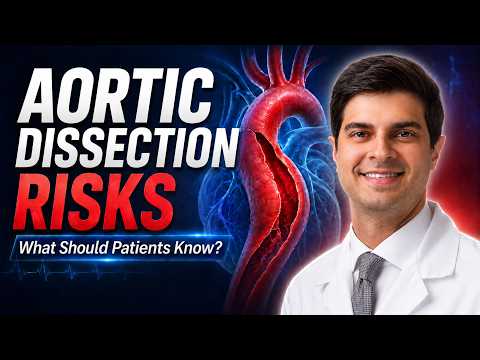

Video available online at:
https://www.youtube.com/watch?v=vZ8GjoJPCIg
Facts About Aortic Dissection Risks
Here are the key insights shared by Dr. Mehta:
Determining the risk of dissection is more complicated than just a number. Dr. Mehta said, “I have a lot of patients like this who have an aneurysm that is not necessarily at the threshold for needing surgery, but they hear the word aneurysm, and they get very concerned that they can have a dissection at any moment. In terms of risk, it’s a little more nuanced than just a number. A 4.7-centimeter aneurysm in somebody small in stature is very different than someone who is of bigger stature. Instead, we look for certain high-risk features to understand what the risk really means, including family history of aortic dissection, a history of connective tissue disorders, growth rate, and whether it is growing rapidly. In this case, it sounds like the aneurysm has been stable over several years.”
There are other things to consider besides the size of the aneurysm. “We look at many different things,” said Dr. Mehta. “For Cindy’s husband, the typical threshold for surgery would be about 5.0 centimeters, or if his moderate aortic regurgitation were to progress to the more severe range with symptoms. Either of those things may prompt the surgery.”
The risk of dissection versus the risk of surgery. Dr. Mehta explained that Cindy’s husband’s current risk is relatively low. “It’s probably a one percent risk of aortic dissection per year or even less than that, which is reassuring,” he said. “Sometimes people ask me why we don’t operate at any size if there is an aneurysm, and the reason is that surgery also has a risk. We can’t, in good faith, offer surgery if the risk of surgery is higher than the risk of dissection at the current aneurysm size. That’s how we weigh the surgical threshold in patients.”
Cindy had a follow-up question for Dr. Mehta: “Is it true that new studies are showing extremely rare dissections for bicuspid aortic valve patients?” Dr. Mehta answered, “Some studies looking at the biomechanics of blood flow in patients with bicuspid aortic valves suggest the risk is different from that with a trileaflet aortic valve. I would warrant caution in thinking that a bicuspid aortic valve is “protective” against the dissection. Most of the evidence in the medical literature is that a bicuspid aortic valve is a risk factor for aortic aneurysm growth and dissection. Although there may be some contrary studies to suggest otherwise, the aortic expert surgical community believes that a bicuspid aortic valve is a risk factor for aortic-related morbidity.”
Thanks Dr. Mehta and Northwestern Medicine!
On behalf of all the patients in our community, thank you, Dr. Chris Mehta, for everything you and your team are doing at Northwestern Medicine in Chicago, Illinois.
Related links:
Keep on tickin,
Adam
P.S. For the deaf and hard-of-hearing members of our patient community, we have provided a written transcript of our interview with Dr. Mehta below.
Written by Adam Pick
Patient & Website Founder

Written by Adam Pick - Patient & Website Founder
Adam Pick is a heart valve patient and author of The Patient's Guide To Heart Valve Surgery. In 2006, Adam founded HeartValveSurgery.com to educate and empower patients. This award-winning website has helped over 10 million people fight heart valve disease. Adam has been featured by the American Heart Association and Medical News Today.
Video Transcript:
Adam Pick: Hi, everybody. It's Adam with HeartValveSurgery.com, and we are at the American Association for Thoracic Surgery Conference in Chicago, Illinois. I'm thrilled to be joined by Dr. Chris Mehta, who's the director of bicuspid aortic valve program and the aortic dissection program at the Bluhm Cardiovascular Institute at Northwestern Medicine here in Chicago. Dr. Mehta, it is great to see you again, and thanks for being with me today.
Dr. Chris Mehta: Thanks for having me, Adam.
Adam Pick: Yeah, so we're here at AATS. There's a lot of presentations and talks and learning going on about valve disease. We're also getting questions from patients from all over the world coming in. This one is right in the specialty of your practice. It's from Cindy, and she asks, "Hi Adam, my husband has a bicuspid aortic valve with moderate regurgitation and a 4.7 centimeter ascending aneurysm. He's 35 and has been stable for four years. Although the measurements have not changed, we do yearly checkups. I remain very concerned about the risk of dissection. How should we interpret his current risk?"
Dr. Chris Mehta: Yeah, that's a great question, Adam. I have a lot of patients like this who have an aneurysm that is not necessarily at the threshold for needing surgery yet, but they hear the word aneurysm, and they get really concerned that they can have a dissection at any moment.
In terms of risk, it's, it's a little more nuanced than just a number. You know, a 4.7 centimeter aneurysm in somebody who's small stature is very different than somebody who is of bigger stature. We look for certain high-risk features to understand what the risk really means. So those high-risk features include a family history of aortic dissection, a history of connective tissue disorders, the rate of growth, if it's growing rapidly, or as sounds like in this case, it's stable over several years.
So, you know, we look at many different things. For this patient, the typical threshold for surgery would be at about 5.0 centimeters, or if that moderate aortic regurgitation progresses to the more severe range with symptoms. Either of those things may prompt the surgery. His current risk, uh, is, is relatively low.
It's probably one percent risk of aortic dissection per year or even less than that. So, that's reassuring. Sometimes people ask me, "Well, why don't you just operate at any size if there's an aneurysm?" And the reason for that is because surgery itself has a risk too, right? So, we can't in good faith say, "We'll offer you surgery," if the risk of surgery is higher than the risk of bad things happening at your current size.
That's how we sort of weigh the surgical threshold in patients.
Adam Pick: Super helpful, Dr. Mehta. And Cindy has a follow-up question- Yeah ... which is, " Is it true that new studies are showing extremely rare dissections for bicuspid aortic valve patients?"
Dr. Chris Mehta: There are some studies looking at sort of the biomechanics of, um, blood flow in patients with, um, bicuspid aortic valves that may suggest that, um, you know, it, it's a little bit different than a trileaflet aortic valve in terms of the risk. I would warrant caution on thinking that a bicuspid valve is, quote-unquote, "protective" against the dissection.
I think the majority of the evidence in the medical literature, most of what we understand is that a bicuspid aortic valve is a risk factor for aortic aneurysm growth and for aortic dissection. So, although there may be some contrary studies to suggest otherwise, the aortic expert surgical community feels that a bicuspid aortic valve is a risk factor aortic-related morbidity.
Adam Pick: Very helpful. And if there's one thing I've learned, Dr. Mehta, about you and the team at Northwestern over the years, is your commitment to patient care by going above and beyond. And for example, I know that you've launched a set of programs for surveillance and something I think called CODE AORTA.
Can you share with our community what, what those programs are?
Dr. Chris Mehta: I'd be happy to. It's, it's sort of a pet project of mine. So, the CODE AORTA program at Northwestern launched in 2020. It's a comprehensive multidisciplinary, uh, program designed for people with acute aortic emergencies, things like aortic dissections and aortic ruptures.
The goal is to get timely definitive intervention for these patients. Many of whom are sitting in an ER for several hours before they can even have the surgery that they need. So part of our code aorta process is what's called our direct to OR program, um, where we help facilitate bringing those patients straight to the operating room.
When they hit the doors of Northwestern, they don't stop in an ER, they don't stop in an ICU, they just come straight to the operating room. We've actually published on this and shown that it actually saves time because as you know, Adam, you know, these are, um, life-threatening emergencies where quite literally every hour counts.
So we've been able to save time by taking patients straight to the operating room. In terms of surveillance, you know, type A dissection is not a one and done event. Many patients after their surgery for aortic dissection will need further interventions in the future, something like one in three patients.
And part of our program that we really emphasize is long-term continuity of care. So we have what I call an active surveillance program not a passive one, meaning we want patients to be getting routine CT scans and echocardiograms at least once a year, you know, moving forward after their surgery to make sure they don't need something else.
And what I mean by active is, you know, we don't just say, "Oh, get a scan and, you know, call us if you need us." We have a dedicated team of people who call and say, "Listen, you missed your appointment. You need to get this scan. You need to get this echocardiogram. We're really concerned about you." So we have a really invested team, um, to make sure people get the long-term care that they need as well.
Adam Pick: Well, fantastic. And on behalf of the patients in our community, patients all over the world, Dr. Mehta, thanks to you and your team at Northwestern Medicine for taking such great care of these patients. Thanks for everything you're doing. Thanks for being with me today.
Dr. Chris Mehta: Thanks, Adam.
New Patient Posts


The Patient's Guide
This book has helped over 47,000 patients and caregivers from diagnosis to recovery.
Surgeon Spotlight


Dr. Joel Corvera is a world-renowned heart valve surgeon that has performed thousands of heart valve operations.