

Mitral Regurgitation - Symptoms, Diagnosis & Treatment
Written By: Adam Pick, Patient Advocate, Author & Website Founder
Medical Expert: Patrick McCarthy, MD, Northwestern Medicine
Page Last Updated: February 26, 2026
Mitral regurgitation is a valvular disease in which the mitral leaflets, which are comprised of two tissue flaps, do not seal properly. As a result, blood leaks backwards in your heart forcing a constant strain on your cardiac muscle. Over time, this disorder can result in many complications including atrial fibrillation, an enlarged heart and congestive heart failure.

So you know, this type of disease is also known as mitral incompetence and mitral insufficiency, although most patients refer to it as a leaking heart valve. A mitral valve prolapse is the most common anatomical defect that causes mitral valve regurgitation.
To help you learn about mitral regurgitation, I recently filmed this video with Dr. Patrick McCarthy, the Chief of Cardiac Surgery at Northwestern Memorial Hospital in Chicago, Illinois.

Video available online at:
https://www.youtube.com/watch?v=Kc01Kk9BpG8
As you can see in the diagram below, the leaflets do not seal tightly across the valve. As a result, the blood flows backwards forcing the heart to "re-pump" the blood to the rest of the body.

Interestingly, this valvular disorder is a very common form of heart valve disease. In fact, The Mayo Clinic suggests that one in five people, or 20 percent, over the age of fifty-five have some degree of a leaking mitral valve. Like most valvular disorders, there are different degrees, or levels, of diagnosis. The main diagnostic categories of mitral insufficiency are mild, moderate and severe regurgitation.
What Are Mitral Valve Regurgitation Symptoms?
Mitral regurgitation symptoms typically manifest as the heart valve disease develops. Most of the time, mitral regurgitation progresses slowly over a period of many years. According to The Cleveland Clinic, the common mitral regurgitation symptoms are:
Shortness of breath, especially during exercise or when you are laying still
Fatigue, especially during exercise
Cough, often during the night, when in bed
Heart palpitations, or fluttering heartbeats, atrial fibrillation
Swollen feet or swollen ankles
Heart murmur, muffled heartbeat
Excessive urination
Patients should be made aware that (i) mitral regurgitation can be an asymptomatic disease and (ii) the disease can, in some cases, progress quickly. Recently, I spoke with a female patient who experienced a rapid degeneration of her mitral valve. In just six months, her moderate regurgitation advanced to severe regurgitation. To ensure proper cardiac function, please remember to get regular, annual check-ups if you have been diagnosed with a heart murmur, a mitral valve prolapse or mitral valve regurgitation. As a patient advocate, I want you to avoid the unnecessary complications that can occur if this disease is not properly managed.
Diagnosing The Severity Of Mitral Regurgitation
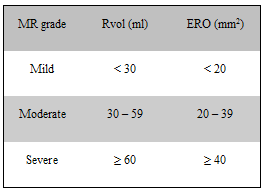
While a stethoscope can help a physician detect mitral valve regurgitation, an echocardiogram is the "gold standard" in determining the severity of the disease. The two main determinants in quantifying the severity of mitral incompetence are:
Regurgitation volume (RVOL) which is the difference between the mitral and aortic stroke volumes; and
Effective regurgitant orifice (ERO) which ratio of regurgitant volume to regurgitant time velocity integral
If you are curious, the table below shows how regurgitation volume and effective regurgitant orifice measurements are used to diagnose leaking mitral valves in patient’s with degenerative disease.
A transesophageal echocardiogram, MRI, stress echo or cardiac catheterization may also be used to further diagnose the valvular disorder, the cardiac damage and the recommended surgical treatment of your mitral valve regurgitation.
When Does Mitral Regurgitation Require Surgical Treatment?
It is critical to note that being diagnosed with mitral insufficiency (or a mitral valve prolapse) does not guarantee your need for open heart surgery. Considering that the disorder progresses over time, most mitral valve operations - mitral valve repair or mitral valve replacement - are an elective procedure. Typically, surgical treatment for this form of mitral disorder occurs only when the patient is diagnosed with "severe" regurgitation.
While some patients, and even cardiologists, feel that surgery is only required when symptoms manifest, this can be problematic. Recently, three of four research papers indicated that asymptomatic patients with severe mitral regurgitation should undergo treatment to preserve proper ventricular function and avoid damage to the cardiac muscle.

Mitral Valve Repair - Annuloplasty Diagram
Again, I encourage all patients who have been diagnosed with this disease, a mitral valve prolapse, or a heart murmur to get annual check-ups and echocardiograms (if needed). The consequences and potential complications of not managing this valvular defect can be very significant and very dangerous.
New Transcatheter Mitral Valve Therapies?
In addition to surgical therapies, new transcathether therapies have been developed for select patient populations that suffer from severe mitral valve regurgitation. The MitraClip, which was approved by the FDA, does not require any trauma to the patient's sternum or ribs. This non-invasive therapy pins the mitral leaflets together to reduce mitral regurgitation.

There are other transcatheter mitral valve replacement (TMVR) technologies that are in clinical studies to determine there effectiveness. For example, the Tendyne TMVR is currently in a feasibility at select clinical sites across the country.
You Might Also Like
To help you learn more about mitral regurgitation, here is new medical information and patient updates:
Written by Adam Pick
Patient & Website Founder

Written by Adam Pick - Patient & Website Founder
Adam Pick is a heart valve patient and author of The Patient's Guide To Heart Valve Surgery. In 2006, Adam founded HeartValveSurgery.com to educate and empower patients. This award-winning website has helped over 10 million people fight heart valve disease. Adam has been featured by the American Heart Association and Medical News Today.
Upcoming Surgeries



Surgeon Spotlight


Dr. Christopher Heid is a leading cardiac surgeon at UT Southwestern in Dallas, Texas who specializes in heart valve repair and replacement operations.