
Weightlifting: Before and After Heart Valve Surgery with Dr. William Brinkman
Written By: Allison DeMajistre, BSN, RN, CCRN
Medical Expert: William Brinkman, MD, Director, Thoracic Aortic Clinic, Baylor, Scott & White, The Heart Hospital-Plano, Plano, Texas
Reviewed By: Adam Pick, Patient Advocate, Author & Website Founder
Published: August 27, 2026
The more we come to understand the importance of building and maintaining muscle as we age, the more people take up a regular weightlifting routine to stay strong and healthy. However, those who are either living with heart valve disease or who’ve already had a surgical repair or replacement may wonder if they need to avoid strenuous activity like weightlifting for fear it will cause further problems with their heart.
We received a patient question on this topic from Shannon, who asked, “Is lifting rather mid to heavy weights putting too much strain on my valve or heart and doing damage? I’ve never received a straight or definitive answer to that question. What are your thoughts?”
Adam Pick, founder of HeartValveSurgery.com, met with Dr. Bill Brinkman to answer Shannon’s question. Dr. Brinkman is a leading aortic valve surgeon and Director of the Thoracic Aortic Clinic at Baylor, Scott & White The Heart Hospital-Plano in Plano, Texas. He’s performed over 3,500 cardiac surgeries, of which 2,500 involved heart valve procedures.
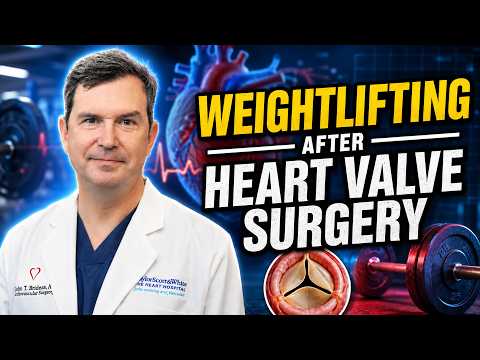

Video available online at:
https://www.youtube.com/watch?v=KqVrbwi9oDQ
Facts About Weightlifting Before and After Heart Valve Surgery
Here are the key insights shared by Dr. Brinkman:
The answer depends on what’s happening with the heart. “That’s an interesting and complex question,” said Dr. Brinkman. “First off, if Shannon has a normal heart and valves, with no aortic aneurysm, I think weightlifting is a good part of an exercise routine.”
Advice after a valve repair. “Now, if you’ve had an aortic valve repair or a Ross Procedure, for example, we often tell people to take it easy on heavy lifting in the early months to a year after the procedure.” Dr. Brinkman explained that straining while lifting heavy weights can increase blood pressure, sometimes to above 200, which might be too much for the freshly repaired valve leaflets.
Advice for aneurysm patients. “We tell people with an aneurysm to refrain from heavy lifting because the wall tension is related to the diameter of the tube. Again, people want to avoid having the systolic blood pressure get too high with an aneurysm because it increases the risk of dissection,” said Dr. Brinkman.
Thanks Dr. Brinkman and Baylor, Scott & White!
On behalf of all the patients in our community, thank you, Dr. Bill Brinkman, for everything you and your team are doing at Baylor, Scott & White The Heart Hospital- Plano in Plano, Texas.
Related links:
See Dr. William Brinkman’s Interactive Surgeon Profile with 80+ Patient Reviews
Ask Dr. Brinkman: The Different Approaches for Treating Bicuspid Aortic Valves
Surgeon Insights: Treating Bicuspid Aortic Valves and Aortic Aneurysms with Dr. William Brinkman
Keep on tickin,
Adam
P.S. For the deaf and hard-of-hearing members of our patient community, we have provided a written transcript of our interview with Dr. Brinkman below.
Written by Adam Pick
Patient & Website Founder

Written by Adam Pick - Patient & Website Founder
Adam Pick is a heart valve patient and author of The Patient's Guide To Heart Valve Surgery. In 2006, Adam founded HeartValveSurgery.com to educate and empower patients. This award-winning website has helped over 10 million people fight heart valve disease. Adam has been featured by the American Heart Association and Medical News Today.
Video Transcript:
Adam Pick: Hi everybody, it's Adam with HeartValveSurgery.com, and we're at the American Association for Thoracic Surgery meeting in Chicago, Illinois. I'm thrilled to be joined by Dr. Bill Brinkman, who is the director of the Thoracic Aortic Clinic at Baylor Scott & White, the Heart Hospital, Plano. Dr. Brinkman, it's great to see you, and thanks for being with me today.
Dr. William Brinkman: Yeah, thank you.
Adam Pick: Yeah, so we're here at AATS, getting lots of great research coming out, speeches, presentations. We're also getting questions from patients in our community. This one comes in from Shannon, and she asks, "Is lifting rather mid to heavy weights putting too much strain on my valve or heart and doing damage?
I have never received a straight, definitive answer to that question. What are your thoughts?"
Dr. William Brinkman: That's an interesting and complex question. But I would say, first off, if she has a normal heart and a normal valve, does not have an aneurysm, let's say, of her aorta, I think weightlifting is a good part of your exercise, and as you might get with any advice for exercise physiology.
Now, if you've had a valve repair, of your aortic valve, or a Ross procedure, for example, in the early months, maybe even out to a year after procedure, we might tell people to take it easy on heavy lifting because when you're straining doing heavy weights, your blood pressure might go up above 200. And that might be a lot on these freshly repaired leaflets.
And if you have an aneurysm, we tell people to refrain from heavy lifting because the wall tension's related to the diameter of the tube. You wanna avoid getting your systolic blood pressure too high if you have an aneurysm, 'cause we think that that might increase your risk for a dissection.
Adam Pick: That is fascinating, Dr. Brinkman, and on behalf of Shannon and all the people in our community, thanks for the work you're doing, both you and your team at Baylor Scott & White, the Heart Hospital Plano. Thanks for being with me today.
Dr. William Brinkman: Thank you so much. Enjoyed it.
New Patient Posts


The Patient's Guide
This book has helped over 47,000 patients and caregivers from diagnosis to recovery.