
Cardiologist Q&A: Transcatheter Innovations for Congenital Heart Valve Disease
Written By: Allison DeMajistre, BSN, RN, CCRN
Medical Expert: Stephen Nageotte, MD, Interventional Cardiologist, Cedars-Sinai
Reviewed By: Adam Pick, Patient Advocate, Author & Website Founder
Published: August 26, 2026
Only a few decades ago, pediatric patients with complex congenital heart disease had limited options for treatments that could successfully lead them into adulthood. Today, the exponential growth of knowledge and innovative treatment interventions has not only given hope to many children and their families but also enabled 90 percent of children in the United States to survive well into adulthood. Much of the progress has been in the realm of congenital valve disease and transcatheter therapies, particularly for children and young adults.
To learn more about the exciting innovation in the field of congenital heart valve disease, we spoke with Dr. Stephen Nageotte, a leading interventional cardiologist at the Guerin Family Congenital Heart Program at Cedars-Sinai Medical Center in Los Angeles, California.
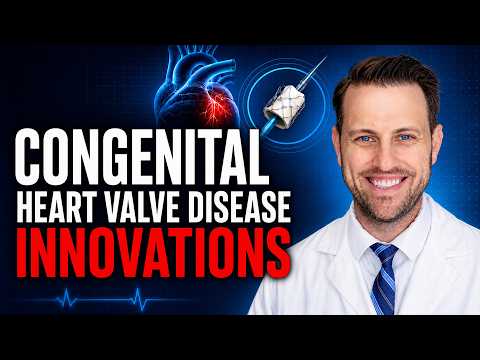

Video available online at:
https://www.youtube.com/watch?v=CimMsXrZsAY
Key Facts About Congenital Heart Valve Disease and Transcatheter Therapy Innovations
Here are the key insights shared by Dr. Nageotte:
Research and innovation continue to expand. “It’s a really exciting time right now to be a congenital interventional cardiologist,” said Dr. Nageotte. “The types of procedures and devices we now have access to have really taken off, particularly over the last five to ten years. Traditionally, we didn’t have access to many different options. There’s been a boom in research and innovation in valves designed for congenital patients, and specifically the self-expanding valves for pulmonary valve replacement.” Dr. Nageotte explained that the extensive research and development devoted to self-expanding valves has enabled their team to treat substantially more patients than with traditional valves.
Besides pulmonary valves, are there any new devices, strategies, or techniques for the aortic, mitral, or tricuspid valves? “In the congenital space, most of the lesions we’re dealing with are with the tricuspid and pulmonary valves, so there is definitely innovation in the tricuspid realm with the structural heart teams.” Dr. Nageotte explained that, because of these important innovations, it’s vital for patients to be part of a comprehensive heart team to ensure access to all available valves, including the aortic, mitral, tricuspid, and pulmonary valves. “There has been even more development in young patients, such that there are now devices coming out that will be studied and possibly put into kids much earlier, possibly three or four years old.”
Lifetime management for congenital heart valve disease starts early. “I think the most important thing is to do the right thing off the bat and set the patient up for success,” said Dr. Nageotte. “When I mentioned those younger patients, that is still an exception to the rule. Usually, for valve replacement, we perform these initial interventions when patients are in their early adolescent or teenage years.” Dr. Nageotte stressed that making the right decision for the first treatment will set patients up for a lifetime of success with valve-in-valve interventions. He explained that the goal is to strategize what is best for each patient.
Thanks Dr. Nageotte and Cedars-Sinai Medical Center!
On behalf of all the patients in our community, thank you, Dr. Nageotte, for everything you and your team are doing at the Guerin Family Congenital Heart Program at Cedars-Sinai Medical Center in Los Angeles, California!
Related links:
Explore the new Congenital Heart Valve Disease Patient Education Center
Free Ebook: Top 8 Facts About Congenital Heart Valve Disease
Keep on tickin,
Adam
P.S. For the deaf and hard-of-hearing members of our patient community, we have provided a written transcript of our interview with Dr. Nageotte below.
Written by Adam Pick
Patient & Website Founder

Written by Adam Pick - Patient & Website Founder
Adam Pick is a heart valve patient and author of The Patient's Guide To Heart Valve Surgery. In 2006, Adam founded HeartValveSurgery.com to educate and empower patients. This award-winning website has helped over 10 million people fight heart valve disease. Adam has been featured by the American Heart Association and Medical News Today.
Video Transcript:
Adam Pick: Hi everybody, it's Adam with HeartValveSurgery.com and we're in Los Angeles, California at Cedars Sinai Medical Center. I'm thrilled to be joined by Dr. Steve Nageotte, who is a leading interventional cardiologist at the Guerin Family Congenital Heart Program here at Cedars Dr. Nageotte, it is great to see you again and thanks for being with me today.
Dr. Stephen Nageotte: Great to see you. Thank you so much for having me.
Adam Pick: We are talking about one of my favorite topics, which is innovation. Can you share with all the folks in our community, the patients and the parents of the patients, what do you see as the most exciting innovation in congenital heart valve disease?
Dr. Stephen Nageotte: It's a really exciting time right now to be a congenital interventional cardiologist because the types of procedures and the types of devices that we now have access to has really taken off, particularly over the last five to 10 years, where traditionally we didn't have access to many different options.
There's really been a boom in terms of research and innovation in in valves that are made. Directly for congenital patients, specifically looking at self-expanding pulmonary valve replacement. There's a lot of research and development going into that technology. Such that the amount of patients that we can now treat with a self-expanding valve is drastically more than prior when we were just dealing with the traditional valves that we had.
Adam Pick: We talked about the pulmonary, any other new devices or strategies or techniques for the aortic, mitral, or tricuspid?
Dr. Stephen Nageotte: In the congenital space, the vast majority of the lesions we're dealing with are tricuspid and pulmonary valve. So, there is definitely innovation in the tricuspid valve realm with the structural heart teams.
I think that's one of the reasons it's important to associate yourself with a complete heart team so that you have access to all the different valves that may be available to aortic, mitral, tricuspid, or pulmonary. There's been even more development in the young patients such that there's now devices that are coming out that will be studied thad may be put in in much earlier kids -- even three to four years of age.
Adam Pick: That was going be my next question. How old were these patients that were receiving these transcatheter techniques? That's really young. And so ultimately do you plan for the lifetime management of that patient with that valve?
Dr. Stephen Nageotte: Yeah. I think the most important thing that you can do is the right thing off the bat.
So setting the patient up for success. When I was mentioning those patients that are much younger, that is still the exception to the rule. More often than not, we're performing these first interventions when the patients are in their early adolescent or teenage years. Uh, in terms of a valve replacement.
It is critical though when you make that first decision that you're making a decision that will set the patient up for a lifetime of success with valve-in-valve interventions and not trying to force a patient down a pathway that may or may not be right for that particular patient and really strategizing what's the best route for that patient in particular.
Adam Pick: Well, Dr. Nageotte, I love how you're tying together not just the innovation. But the lifetime management of the disease for that patient. So on behalf of those patients and the parents out there, thanks to you for everything you and your team are doing here at the Guerin Family Congenital Heart Program at Cedars.
Dr. Stephen Nageotte: Thank you so much. It's really a pleasure.
Upcoming Surgeries


Surgeon Spotlight


Dr. Joel Corvera is a world-renowned heart valve surgeon that has performed thousands of heart valve operations.
The Patient's Guide
This book has helped over 47,000 patients and caregivers from diagnosis to recovery.