
Heart Transplants and Heart Valve Disease: What Should Patients Know?
Written By: Allison DeMajistre, BSN, RN, CCRN
Medical Expert: Laura DiChiacchio, MD, Cardiac Surgeon, Cedars-Sinai, Los Angeles, California
Reviewed By: Adam Pick, Patient Advocate, Author & Website Founder
Published: October 6, 2026
For patients who have had a successful heart transplant, the relief can be overwhelming. They often feel they’ve won a long battle with a failing heart and the wait for a matching donor. Even with this relief, patients know complications can arise, such as organ rejection, infection, and medication side effects. Heart valve disease is a less common condition that may also occur. When patients understand how valve problems can develop in a transplanted heart, they can be better prepared to seek treatment.
To learn more about heart transplant and valve disease, we spoke with Dr. Laura DiChiacchio. She is a leading cardiac surgeon at Cedars-Sinai Medical Center in Los Angeles, California. In addition to Dr. DiChiacchio’s experience with heart valve surgery, she also specializes in heart transplants.
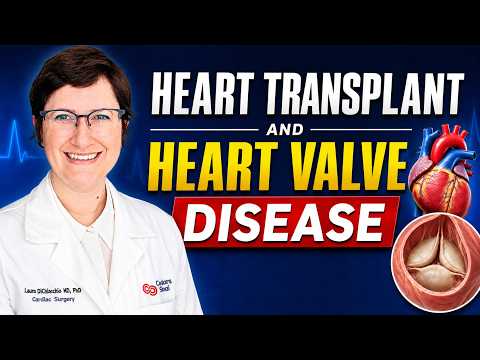

Video available online at:
https://www.youtube.com/watch?v=BUJlJH01cOc
Key Facts About Heart Transplant and Valve Disease
Here are the key insights shared by Dr. DiChiacchio:
Transplanted hearts don’t commonly develop valve problems. "A small group of patients with a transplanted heart develop a problem with one of the valves," said Dr. DiChiacchio. "We’re lucky the incidence of valvular disease on the left side of a transplanted heart, so the aortic and mitral valve, is very low. It is rare that we must intervene again on an aortic or mitral valve."
Monitoring a transplanted heart can affect valve function. Dr. DiChiacchio said, “However, what is unique about transplanted hearts is part of the surveillance and maintenance of those that require biopsies, wires, and catheters that go to the right side of the heart to take small biopsies to make sure there is no rejection occurring. The wires and catheters crossing a tricuspid valve can cause it to leak.”
Interventions and outcomes of heart valve repair after heart transplantation. “I’ve had to go back and do tricuspid valve repairs on patients with transplanted hearts,” said Dr. DiChiacchio. “The patients have done very well. Sometimes it can be approached with a transcatheter option by the interventional cardiology team, but usually if there is a real problem, the most durable fix is to go back for another operation to repair or replace the tricuspid valve.”
Thanks Dr. DiChiacchio and Cedars-Sinai Medical Center!
On behalf of all the patients in our community, thank you, Dr. Laura DiChiacchio, for everything you and your team are doing at Cedars-Sinai Medical Center in Los Angeles, California!
Related links:
Heart Failure and Heart Valve Disease: Early Detection & Life Expectancy
Patient Success: Dr. Dichiacchio Perfoms Christopher ‘Kid’ Reid’s Heart Transplant
Keep on tickin,
Adam
P.S. For the deaf and hard-of-hearing members of our patient community, we have provided a written transcript of our interview with Dr. DiChiaccio below.
Written by Adam Pick
Patient & Website Founder

Written by Adam Pick - Patient & Website Founder
Adam Pick is a heart valve patient and author of The Patient's Guide To Heart Valve Surgery. In 2006, Adam founded HeartValveSurgery.com to educate and empower patients. This award-winning website has helped over 10 million people fight heart valve disease. Adam has been featured by the American Heart Association and Medical News Today.
Video Transcript:
Adam Pick: Hi everybody. It's Adam with HeartValveSurgery.com, and we're in Los Angeles, California at Cedars-Sinai Medical Center. I'm thrilled to be joined by Dr. Laura DiChiacchio, who is a leading cardiac surgeon. Dr. DiChiacchio, it is great to see you again and thanks for being with me today.
Dr. Laura DiChiacchio: Thank you for having me.
Adam Pick: We're going to talk about something I'm very curious to know. Given your specialty in heart transplants, have you ever had a patient or do you hear about patients in literature who may have gotten a heart transplant and then either in the short term or down the road needed heart valve surgery.
Dr. Laura DiChiacchio: This is interesting. Kind of small group of patients who have a transplanted heart develop a problem with one of the valves in that heart. And we're really lucky that the incidence of valvular disease and transplanted hearts on the left side of the heart - so the aortic and mitral valve - is very low. It is rare that we have to intervene again on an aortic or mitral valve.
However, what's unique about transplanted hearts is part of the surveillance and maintenance of the hearts requires biopsies, wires, and catheters that go to the right side of the heart to take small biopsies and make sure that there's no rejection occurring, and the constant wires and catheters going across a tricuspid valve can cause leaky tricuspid valves.
I have, in my career, had to go back and do tricuspid valve repairs on patients who have transplanted hearts. The patients have done very well. Sometimes this can be approached from a transcatheter option with the interventional cardiology team, but usually if there's a real problem the most durable fix is to go back for another operation to repair or replace the tricuspid valve.
Adam Pick: Very interesting. On behalf of patients, although you said it's a small group of folks, I cannot thank you enough for your research and your commitment, not only to heart transplants. But then to valvular disease as well. Thanks to you and everything you're doing here at Cedars-Sinai. Thanks for being with me today.
Dr. Laura DiChiacchio: Thank you.
New Patient Posts


Adam's Video Library

Learn about heart valve surgery and patient success stories at Adam's video library.