

Bicuspid Aortic Valve Repair: 15-Year Outcomes with Dr. Ismail El-Hamamsy
Written By: Allison DeMajistre, BSN, RN, CCRN
Medical Expert: Ismail El-Hamamsy, MD, Director of Aortic Surgery, Mount Sinai Health, New York, New York
Reviewed By: Adam Pick, Patient Advocate, Author & Website Founder
Published: August 28, 2026
For decades, the primary treatment for symptomatic bicuspid aortic valve disease has been surgical aortic valve replacement with either a mechanical or tissue valve, or the Ross Procedure. More recently, transcatheter aortic valve replacement has also emerged as a viable option. Over the past 20 years, researchers and surgeons have developed techniques for BAV repair, believing that keeping one's own tissue may offer better overall outcomes than a replacement valve.
To learn more about the latest research and surgical outcomes on this topic, we spoke with Dr. Ismail El-Hamamsy about an oral abstract presentation on BAV repair that he would be giving at the American Association for Thoracic Surgery Annual Meeting. Dr. El-Hamamsy is the Director of Aortic Valve Surgery at Mount Sinai Health in New York. He is widely acknowledged as one of the world’s best aortic surgeons and a distinguished researcher with more than 200 published scientific papers in several prominent peer-reviewed journals.
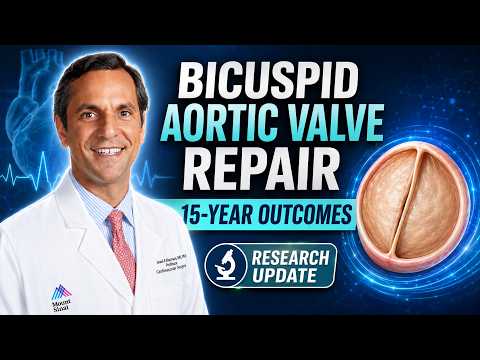

Video available online at:
https://www.youtube.com/watch?v=LXD6FiRGB8E
Facts About the 15-Year Outcomes of BAV Repair Surgery
Here are the key insights shared by Dr. El-Hamamsy:
The explanation of the abstract and subject presentation. Dr. El-Hamamsy explained, “An abstract is essentially a study that we present in an oral format in front of all the attendees. We’re here at the AATS, which is the main cardiac surgery conference in our field. We’re looking at a study in which we analyzed the long-term outcomes of patients with leaking bicuspid valves who had their valves repaired rather than replaced. This is very novel because most centers or surgeons will typically default to replacing bicuspid valves or leaky bicuspid valves.”
Bicuspid valve repair versus mitral valve repair. “About 20 years ago or so, we started to get interested in the concept of repairing aortic valves, very much like we do with mitral valves,” said Dr. El-Hamamsy. “And we know that when we repair a mitral valve, we can restore the patient’s survival, quality of life, and exercise capacity in the long term. Our question was, ‘Can we do the same on the aortic side?’”
Surgical repair approaches and outcomes over 15 years. “The techniques evolved and improved, and there was a clear understanding of the mechanisms of why these valves leak, and the patient selection got better. The data we’re presenting today analyzes the 15-year outcomes of patients who underwent bicuspid valve repair. I’m very happy to report that in patients who qualify for a repair of their bicuspid valve, the results up to 15 years are very good in two ways. First, their survival is identical to that of the general population, matched for age and sex. Second, valve function is well preserved during the first 15 years after bicuspid valve repair.”
The knowledge gained over 15 years. “We’ve also learned it’s a technical operation, and there is a learning curve,” said Dr. El-Hamamsy. “Our early results are not quite the same as our later results. The technical principles are now very clearly defined, and our selection of which patients should have a repair and which should not is also much more refined than it used to be.”
The working criterion decision about repair or replacement. “I always tell patients that when we have young people with bicuspid valves that have regurgitation, we’re going to repair them if we meet two conditions, which are if it is doable, and equally importantly, if we think it will be durable. Doable and durable.” Dr. El-Hamamsy added that most valves can be repaired, but not all repairs will last long enough to justify repair over replacement.
Thanks Dr. El-Hamamsy and Mount Sinai Health!
On behalf of all the patients in our community, thank you, Dr. Ismail El-Hamamsy, for everything you and your team are doing at Mount Sinai Health in New York City!
Related links:
See Dr. Ismail El-Hamamsy's Interactive Surgeon Profile with 50+ Patient Reviews
Surgeon Q&A with Dr. Ismail El-Hamamsy: Ross Procedure Survival Advantages for Aortic Valve Disease
Keep on tickin,
Adam
P.S. For the deaf and hard-of-hearing members of our patient community, we have provided a written transcript of our interview with Dr. El-Hamamsy below.
Written by Adam Pick
Patient & Website Founder

Written by Adam Pick - Patient & Website Founder
Adam Pick is a heart valve patient and author of The Patient's Guide To Heart Valve Surgery. In 2006, Adam founded HeartValveSurgery.com to educate and empower patients. This award-winning website has helped over 10 million people fight heart valve disease. Adam has been featured by the American Heart Association and Medical News Today.
Video Transcript:
Adam Pick: Hi, everybody, it's Adam with HeartValveSurgery.com, and we're at the American Association for Thoracic Surgery Conference in Chicago, Illinois. I'm thrilled to be joined by Dr. Ismael El-Hamamsy, who's the Director of Aortic Surgery at Mount Sinai Health in New York City, New York. Dr. El-Hamamsy, it is great to see you again, and thanks for being with me today.
Dr. Ismail El-Hamamsy: Adam, it's always good to see you.
Adam Pick: We're here at AATS. There's a lot of presentations, speeches and talks going on. I understand that you're giving an oral abstract about bicuspid aortic valve repair. Can you share with our community what an abstract is and what you're going to be talking about?
Dr. Ismail El-Hamamsy: Thank you. An abstract is essentially a study that we present in an oral format in front of all the attendees.
We're here at the AATS, which is the main cardiac surgery conference in our field. And the study that we're looking at was a study where we analyzed the outcomes, the long-term outcomes of patients whose bicuspid valves that were leaking were repaired instead of being replaced. Now, this is really very novel, in the sense that most centers or most surgeons will typically default to replacing bicuspid valves or leaky bicuspid valves.
About 20 years ago or so, we started to get interested in the concept of repairing aortic valves, very much like we do with mitral valves. And we know that when you repair a mitral valve, you can restore the patient's survival and quality of life and exercise capacity in the long term. And the question was, can we do the same on the aortic side?
So, the techniques evolved and were improved, and there was a clear understanding of the mechanisms of why these valves leak, and the patient selection got better and better. And the data we're showing today is data that analyzes the 15-year outcomes of these, uh, patients that had bicuspid valve repair.
And I'm very happy to report that in patients who qualify for a repair of their bicuspid valve, the results up to 15 years are very good in two ways. One, their survival is exactly identical to the general population matched for age and sex and secondly, valve function is very well preserved during that first 15 years after repairing that bicuspid valve. What we've also learned is, is that it's a technical operation. There's no doubt about it. There is a learning curve. Our early results are not quite the same as our later results.
The technical principles are now very clearly defined, and our selection of which patients should be repaired and which patients should not be repaired is also much more refined than it used to be. So I always tell patients when we have young people with bicuspid valves that have regurgitation, we're going to repair them if we meet two conditions: one, if it is doable And equally importantly, if we think it's going to be durable.
Doable and durable. Because most valves can be repaired, but not all of them will last, you know, a long time to justify repairing the valve. So that's what we've learned, that's what we're excited to share with, uh, all the attendees here, and we hope that this field continues to grow because I really think it, it serves patients in a very unique way.
Adam Pick: Yeah. Well, I'm equally excited because as you and I have talked about before, saving the patient's aortic valve can lead to so many benefits for them over their lifetime. So thank you on behalf of the patients in our community, people all over the world. Thanks for everything you are doing at Mount Sinai Health in New York. Thanks for being with me, Dr. El-Hamamsy.
Dr. Ismail El-Hamamsy: Thanks for all you do, Adam.
Upcoming Surgeries



Surgeon Spotlight


Dr. Joel Corvera is a world-renowned heart valve surgeon that has performed thousands of heart valve operations.
Heart Hospital Map

Search for heart hospitals that specialize in heart valve treatment.