
Aortic Stenosis Progression: How To Stop It?
Written By: Allison DeMajistre, BSN, RN, CCRN
Medical Expert: Eric Roselli, MD, Chief of Adult Cardiac Surgery, Cleveland Clinic, Cleveland, Ohio
Reviewed By: Adam Pick, Patient Advocate, Author & Website Founder
Published: August 24, 2026
Patients at risk of aortic stenosis hear a lot about how to prevent the disease, such as controlling blood pressure, lowering cholesterol, a healthy diet, regular exercise, and not smoking. Patients already living with aortic stenosis usually find that the only treatment for the disease is valve replacement. There’s not much information, though, about how to slow or stop the progression of aortic stenosis. So, when we received a patient question from Sharon on this topic, we wanted to provide her and our whole community with an answer.
Sharon wrote to us and asked, “Is there any new research on how to delay or stop the progression of aortic stenosis? Can you tell me anything about Valvosoft or HMR766 (also known as Ataciguat)?” We spoke with Dr. Eric Roselli at the American Association for Thoracic Surgeons’ annual meeting to get some answers. Dr. Roselli is the Chief of Adult Cardiac Surgery at the Cleveland Clinic in Cleveland, Ohio. He’s performed thousands of heart valve surgeries and specializes in complex aortic valve procedures.
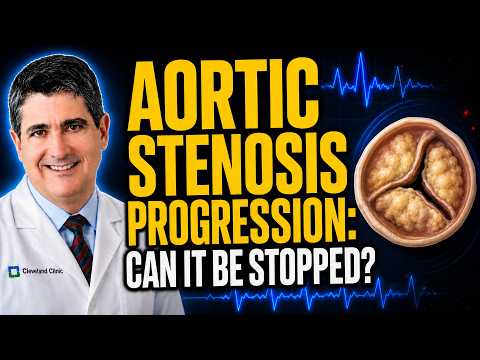

Video available online at:
https://www.youtube.com/watch?v=mtyiFTipcM0
Facts About How to Stop the Progression of Aortic Valve Stenosis
Here are the key insights shared by Dr. Roselli:
Research investigating statin therapy and coronary artery disease. Dr. Roselli explained that the Valvosoft and Ataciguat that Sharon mentioned are investigational and are still being studied and tested. He said, “What we have looked at are more straightforward questions about the similarities between the risk factors for aortic stenosis and those for coronary artery disease. For a long time, we recognized the importance of managing your overall cardiovascular health and taking a statin to control cholesterol.” Dr. Roselli described a study in which patients with aortic valve stenosis were randomized into two groups. One group was given aggressive statin therapy while the other was not. “Interestingly, patients in both groups progressed to needing a valve replacement at the same pace. But patients who had aggressive statin therapy were less likely to need bypass surgery at the time of a valve replacement. So, we know that statin therapy is good for coronary artery disease, and even though the risk factors for coronary artery disease and aortic stenosis mirror each other, the treatment process is probably not the same.”
Research and investigational studies that could help delay the progression of aortic stenosis. Dr. Roselli said, “There’s been a shift in direction where we ask, ‘What else can we do?’ Antaciguat, the medicine Sharon mentioned, is in clinical trials. It targets a different mechanism of calcified plaque formation on valves with the hope that it might slow it down. They have good theoretical science behind it, and maybe some animal studies, but that’s all I can tell you right now because there is no data available.”
Valvosoft and aortic stenosis. “The problem with aortic stenosis is that when we identify someone with a bad aortic valve, a lot of times the process is too far gone because once you have calcium, it’s already late-stage disease. Now, Valvosoft is a mechanical tool that goes in and breaks down some of that hard calcium. It’s believed to make valve leaflets more mobile, which can make the valve last a bit longer. Valvosoft is still in clinical trials. I don’t know of any places in the US doing it, but I think they’re doing it in Europe. It could buy some time and may become a tool that helps physicians break down some of the disease process, making someone more amenable to a transcatheter valve.”
Having a healthy heart is the priority. Dr. Roselli said, “Keep doing your research, Sharon; that’s awesome. Also, when you get to the point where you need your valve to be replaced, remember it’s not just about the valve; it’s about the heart. The heart comes first. You need good valves to have a heart that’s healthy and working well for a lifetime.”
Thanks Dr. Roselli and the Cleveland Clinic!
On behalf of all the patients in our community, thank you, Dr. Eric Roselli, for everything you and your team are doing at the Cleveland Clinic in Cleveland, Ohio!
Related links:
Keep on tickin,
Adam
P.S. For the deaf and hard-of-hearing members of our patient community, we have provided a written transcript of our interview with Dr. Roselli below.
Written by Adam Pick
Patient & Website Founder

Written by Adam Pick - Patient & Website Founder
Adam Pick is a heart valve patient and author of The Patient's Guide To Heart Valve Surgery. In 2006, Adam founded HeartValveSurgery.com to educate and empower patients. This award-winning website has helped over 10 million people fight heart valve disease. Adam has been featured by the American Heart Association and Medical News Today.
Video Transcript:
Adam Pick: Hi, everybody. It's Adam with HeartValveSurgery.com and we're at the American Association for Thoracic Surgery meeting in Chicago, Illinois. I'm thrilled to be joined by Dr. Eric Roselli, who is the chief of adult cardiac surgery at the Cleveland Clinic in Cleveland, Ohio. Dr. Roselli, it is great to see you again, and thanks for being with me today.
Dr. Eric Roselli: Of course, Adam. Always a pleasure.
Adam Pick: Yeah, so we're here at AATS. A lot of great information and new research is coming out. We're also getting questions from patients coming in at us from all over the world. This one- Fire away, man. Yeah, this one- Yeah ... is your specialty. Yeah. Coming in from Sharon, she asks, "Is there any new research about how to delay or stop the progression of aortic stenosis? Can you tell me anything about Valvosoft, or what about HMR766?"
Dr. Eric Roselli: Those are a couple of investigational things.
What we have looked at is some of the more straightforward sort of questions that have been around, that we know risk factors for aortic stenosis mirror the risk factors for coronary artery disease. So for a long time we thought, well, manage your overall health, cardiovascular health, make sure you take your statin and treat your lipids, you know, cholesterol well.
Um, interestingly, when they did studies where they randomized patients to really aggressive statin therapy in patients who had aortic stenosis, uh, randomized to either get it that way or just or not, the patients progressed to need their valve replaced at the same pace. But the patient, patients who had the really aggressive statin therapy were less likely to need bypass surgery at the time of the valve.
So we know that that therapy is good for coronary disease, even though the risk factors mirror each other, probably not the z- exactly the same process on the valve. And so there's been a shift in direction of like, what else can we do? That medicine A- ata- atusiguat it's in clinical trials, it, targets a, a different mechanism of the kind of calcified plaque formation on valves with the thought that maybe it'll slow it down.
That's all I can tell you right now 'cause there's no data available. Um, certainly they've got, uh, good theoretic science behind it, um, maybe some animal studies. Um, and, uh, keep asking those questions, Sharon, 'cause I think we're gonna see more and more new data around it. Um, the problem is a lot of times when we identify someone with a bad aortic valve, the process is already pretty far gone.
It's like a pretty severe late stage. Once you have calcium, it's pretty late stage disease. Now, there's these other things, uh, there's like Valvosoft is a mechanical tool that goes in and sort of breaks down some of that hard calcium and stuff, and the thought is, you know, you get to make the leaflets more mobile, then you can ride your own leaflet out a little bit longer.
Um, that's also in trials. Uh, I don't know of any places in the US doing it. I think they're doing it in Europe. Um, and, um, we'll see. That could potentially buy you some time Uh, it may end up being a tool that also maybe helps, uh, physicians to, you know, break down some of the disease process and make someone more amenable to a transcatheter valve.
Um, still really, really early, not ready for primetime, but, um, keep doing your homework, Sharon. That's awesome. Uh, but also don't be afraid of, you know, when you get to the point where you need your valve replaced, remember that the whole question, we focus on valve, valve, valve, valve, heartvalvesurgery.com, right?
It's all about the valve. It's not the valve. It's the heart. The heart, heart valve. The heart comes first. So you need good valves to have a heart that's healthy, that allows you to have it working well for a long lifetime.
Adam Pick: Great. Well, Sharon, I hope that helped you. I know it helped me. And Dr. Roselli, as always, thanks for everything you and your team are doing at Cleveland Clinic.
Dr. Eric Roselli: Of course. Thanks.
Upcoming Surgeries


Surgeon Spotlight


Dr. Joel Corvera is a world-renowned heart valve surgeon that has performed thousands of heart valve operations.