
The Ross Procedure: Treatment Guidelines, Advantages and Surgeon Experience with Dr. William Brinkman
Written By: Allison DeMajistre, BSN, RN, CCRN
Medical Expert: William Brinkman, MD, Director, Thoracic Aortic Clinic, Baylor, Scott & White, Plano, Texas
Reviewed By: Adam Pick, Patient Advocate, Author & Website Founder
Published: August 11, 2026
The Ross Procedure is perhaps one of the most complex heart operations surgeons can perform. While it is technically an aortic valve replacement surgery, it also involves removing the pulmonary valve and implanting it in the aortic position. A donor valve is then used to replace the pulmonary valve. The Ross Procedure has several advantages, including highly successful patient outcomes. Still, its advantages depend on specific treatment guidelines and a surgeon’s experience, which patients considering the Ross Procedure for aortic valve disease shouldn’t overlook.
To get more information about the current guidelines and advantages of the Ross Procedure, we spoke with Dr. William Brinkman, Director of the Thoracic Aortic Clinic at Baylor Scott & White The Heart Hospital-Plano in Plano, Texas. Dr. Brinkman has performed over 3,500 cardiac surgeries and has nearly 20 years of experience with the Ross Procedure.
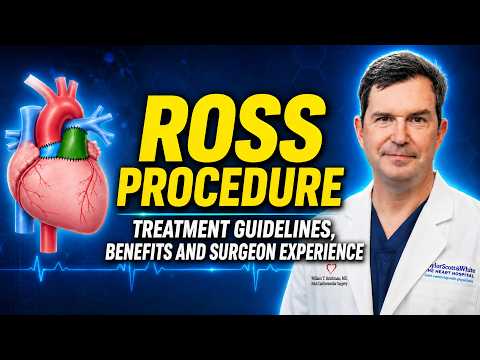

Video available online at:
https://www.youtube.com/watch?v=IIWYdVfhyeI
Facts About Ross Procedure Guidelines, Advantages, and Surgeon Experience
Here are the key insights shared by Dr. Brinkman:
The current data about what is necessary for a successful Ross Procedure. Dr. Brinkman said, “The treatment guidelines for the use of the Ross Procedure are evolving, and there is more data coming out. Right now, it has what we call a 2B indication, which means it’s reasonable if it’s done at a comprehensive Ross Center, where you have an experienced surgeon and imaging team that decides if you have the proper anatomy for the Ross. I think if you have the proper anatomy and an experienced surgeon, the Ross is a beautiful thing, and it has very good results.”
The benefits and results for patients. “It’s the only valve operation that puts you back on a normal life expectancy curve,” explained Dr. Brinkman. “You don’t have to be on Coumadin, which decreases the incidence of bleeding and thromboembolic events. I also believe the flow through the heart is more natural, and the leaflets of the autograft are intended by nature to be leaflets, so I think there is some advantage to that.”
What is the significance of an experienced team and a volume threshold? “Like many complex surgical procedures, there is a volume quality threshold,” said Dr. Brinkman. “The Ross is a very complex procedure, and it takes years for a surgeon to get the cases where they would be considered an expert in the area. We are working with societies to help surgeons and centers become experts if that is what they want. But I think it needs to be done in a very controlled manner, rather than by small-volume operators at small-volume hospitals, because those settings don’t tend to yield the best results.”
Thanks Dr. Brinkman and Baylor, Scott & White!
On behalf of all the patients in our community, thank you, Dr. Bill Brinkman, for everything you and your team are doing at Baylor, Scott & White The Heart Hospital- Plano in Plano, Texas.
Related links:
See Dr. William Brinkman’s Interactive Surgeon Profile with 80+ Patient Reviews
Ask Dr. Brinkman: The Different Approaches for Treating Bicuspid Aortic Valves
Surgeon Insights: Treating Bicuspid Aortic Valves and Aortic Aneurysms with Dr. William Brinkman
Keep on tickin,
Adam
P.S. For the deaf and hard-of-hearing members of our patient community, we have provided a written transcript of our interview with Dr. Brinkman below.
Written by Adam Pick
Patient & Website Founder

Written by Adam Pick - Patient & Website Founder
Adam Pick is a heart valve patient and author of The Patient's Guide To Heart Valve Surgery. In 2006, Adam founded HeartValveSurgery.com to educate and empower patients. This award-winning website has helped over 10 million people fight heart valve disease. Adam has been featured by the American Heart Association and Medical News Today.
Video Transcript:
Adam Pick: Hi everybody, it's Adam with HeartValveSurgery.com, and we're at the American Association for Thoracic Surgery meeting in Chicago, Illinois. I'm thrilled to be joined by Dr. Bill Brinkman, who is the director of the Thoracic Aortic Clinic at Baylor Scott & White, the Heart Hospital, Plano. Dr. Brinkman, it is great to see you again, and thanks for being with me today.
Dr. William Brinkman: Great to see you.
Adam Pick: So we're here at AATS, and when we get together, we seem to always talk about the Ross procedure, which is one of your specialties. I'm a Ross procedure patient, and I'm just curious to know, as you have worked on your techniques and you've seen the data come out, how has that or has it not impacted the treatment guidelines for aortic valve disease?
Dr. William Brinkman: Well, the treatment guidelines for the use of the Ross is evolving, and there's more data coming out, but right now it has what we call a 2B indication, which means it's reasonable if it's done at a comprehensive Ross center, where you have an experienced surgeon and an experienced imaging team that decides if you have the proper anatomy for the Ross.
And I think if you have the proper anatomy and you have an experienced surgeon, the Ross is a beautiful thing, and it has very good results.
Adam Pick: So let's talk about the beautiful thing. For you, the results and the benefits for the patients are what? Well, primarily
Dr. William Brinkman: it's the only valve operation that puts you back on a normal life expectancy curve,
You don't have to be on Coumadin. It decreases your incidents of bleeding and thromboembolic events. And I also personally believe that the flow through the heart is more natural, and the leaflets of the autograft are intended by nature to be leaflets, so I think there is some advantage to that
Adam Pick: You mentioned the experience of the teams to perform the Ross procedure. I imagine a lot of patients are wondering, what does that mean? Is there a certain volume threshold in which is ideal for a patient to go actually get this very complex procedure done?
Dr. William Brinkman: Yeah, like a lot of complex procedures in surgery, there is a volume quality threshold, and ROSS is a very complex procedure, and it takes years for a surgeon to get the cases where they would be considered an expert in the area.
We are working with the societies also to help surgeons and centers become experts if they wanna be experts. But I think it needs to be done in a very controlled manner rather than just small volume operators at small volume hospitals. Those don't tend to get the best results.
Adam Pick That, that is great advice, great points. Great for the people in our community to hear from you, Dr. Brinkman. Yeah. And as always, thanks for the work you're doing, both you and your team at Baylor Scott & White, the Heart Hospital. Thanks for being with me today.
Dr. William Brinkman: Thanks. Enjoyed it.
New Patient Posts

Adam's Video Library

Learn about heart valve surgery and patient success stories at Adam's video library.