
Bicuspid Aortic Valves and Aortic Root Enlargement: What Should You Know?
Written By: Allison DeMajistre, BSN, RN, CCRN
Medical Expert: Ciro Amodio, MD, Director of the Aorta Program, University of Miami Health System
Reviewed By: Adam Pick, Patient Advocate, Author & Website Founder
Published: July 17, 2026
A diagnosis of bicuspid aortic valve (BAV) can come as a surprise to people because it’s often asymptomatic and discovered incidentally when a doctor hears a murmur or sees it on a diagnostic test for a different health issue. Although many people with a BAV may never experience a problem, receiving a diagnosis is important since a bicuspid valve can cause serious heart problems including stenosis, regurgitation, and aortic root enlargement, which can lead to an aneurysm. I'm important to note that each of these conditions can be serious and life-threatening. Today, thanks to medical advances, heart surgeons have several different options to treat these conditions.
We received a patient question on this topic from John, who wrote, “I'm 62 and the proud owner of my original bicuspid aortic valve. My root is enlarged to about 4.2 centimeters and an aneurysm of about4.8 centimeters. Is root enlargement a good idea? Can surgeons just reinforce the aneurysm, avoiding graft and coronary reimplantation?” Adam Pick, founder of HeartValveSurgery.com, spoke with Dr. Cioro Amodio, the Director of the Aorta Program at the University of Miami Health System in Miami, Florida. Dr. Amodio specializes in advanced aortic techniques to treat complex aortic diseases.
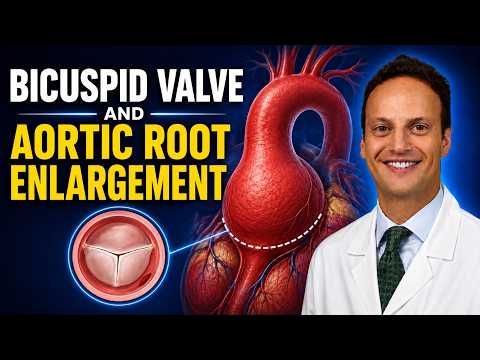

Video available online at:
https://www.youtube.com/watch?v=gPK3w99PyCA
Facts About Bicuspid Aortic Valves and Root Enlargement
Here are the key insights shared by Dr. Amodio:
Treatment for the bicuspid aortic valve and the aneurysm. “This is a very interesting question,” said Dr. Amodio. “Bicuspid aortic valves are a very common congenital anomaly that is present in one to two percent of the population and is strongly associated with bicuspid aortopathy, which is a disease affecting the aorta. In this case, John has a problem with his bicuspid valve and an aortic aneurysm, and normally we would treat both.”
When root enlargement is necessary. Dr. Amodio explained that root enlargements are usually performed in other circumstances when the annulus, the area of the heart where the valve sits, is too small for a patient’s body size. To accommodate a valve large enough for a patient, the surgical team will look at preoperative studies, including a CT scan and echocardiogram, and then match the valve to the patient’s body size. “In this case, if John had a very small annulus, then root enlargement could be a good idea. I think if his root is already dilated, which a normal root is around 2.5 to 3 centimeters, and his is 4.2, he probably doesn’t need an enlargement.”
Other suggestions for John’s treatment. “John might need something done in his annulus, either an annular reinforcement or, if he’s in an aortic center, he should just trust the choices of the surgeon. Sometimes, we can avoid reimplanting the coronaries by replacing the valve, reinforcing the annulus, and then changing the ascending aorta.”
Thanks Dr. Amodio and University of Miami Health System!
On behalf of all the patients in our community, thank you, Dr. Ciro Amodio, for everything you and your team are doing at the University of Miami Health System in Miami, Florida!
Related links:
Keep on tickin,
Adam
P.S. For the deaf and hard-of-hearing members of our patient community, we have provided a written transcript of our interview with Dr. Amodio below.
Written by Adam Pick
Patient & Website Founder

Written by Adam Pick - Patient & Website Founder
Adam Pick is a heart valve patient and author of The Patient's Guide To Heart Valve Surgery. In 2006, Adam founded HeartValveSurgery.com to educate and empower patients. This award-winning website has helped over 10 million people fight heart valve disease. Adam has been featured by the American Heart Association and Medical News Today.
Video Transcript:
Adam Pick: Hi, everybody. It's Adam with HeartValveSurgery.com, and we're at the American Association for Thoracic Surgery meeting in Chicago, Illinois. I am thrilled to be joined by Dr. Ciro Amadio, who is the director of the Aorta Program at the University of Miami Health System in Miami, Florida. Dr. Amadio, it is great to see you.
Dr. Ciro Amodio: Thank you, Adam.
Adam Pick: Yeah, so we are here at AATS. There's a lot of great presentations going on, research talks. We're also getting questions from patients coming at us from all over the world.
This is a question, given your specialty, I'm hoping you can help John and he asks “Hi, Adam. I'm 62 and the proud owner of my original bicuspid aortic valve. My root is enlarged to about 4.2 centimeters and an aneurysm of about 4.8 centimeters. Is root enlargement a good idea? Can surgeons just reinforce the aneurysm, avoiding graft and coronary reimplantation.”
Dr. Ciro Amodio: Yeah, that's a very interesting question. So bicuspid aortic valves are a very common, congenital anomaly that it's present in around one to 2% of the population, and it's strongly associated with bicuspid aortopathy – so, a disease that involves the aorta as well. So in this case, we have a gentleman who has a problem with his bicuspid valve and an aortic aneurysm. So normally we would treat both when we talk about the root, we've just got to make sure that, uh, root enlargements are usually done in other circumstances when actually the annulus the area of the heart where the valve sits inside, it's much smaller for a patient body size.
So you want to make sure that you accommodate a valve that is big enough for you. So these are studies that we do preoperatively based on your CT scan, echocardiogram, and then we match it to your body So in this case, in case he would have a very small annulus, then root enlargements can be a good idea, but I think if his root is already dilated, normally it's around 2.5 to 3, and we're talking about, you said 4.2 Probably he doesn't need a root enlargement, but he might need something done in his annulus, either reinforcing with an annular reinforcement or,
If he's in an aortic center, he should just trust the choices of the surgeon. And, and sometimes, uh, you know, we can avoid reimplanting the coronaries, just replacing the valve, reinforcing the annulus, and then changing the ascending aorta.
Adam Pick: Great. Well, Dr. Amadio, on the behalf of John, thank you for sharing all that great information, not just for his case, but about aortic root enlargement.
And I loved what you said about going to a center that specializes in the aorta to ensure that this is taken care of properly. And behalf of John- Absolutely ... all the people in our community, thanks so much to you and your team at the University of Miami Health System.
Dr. Ciro Amodio: Thank you so much!
Upcoming Surgeries



Adam's Video Library

Learn about heart valve surgery and patient success stories at Adam's video library.