
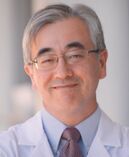
Dr. Mamoo Nakamura
Dr. Mamoo Nakamura
Interventional Cardiologist



Dr. Mamoo Nakamura


About Dr. Mamoo Nakamura,
Interventional Cardiologist
Hello! My name is Dr. Mamoo Nakamura and I am a interventional cardiologist having graduated from Mie University School of Medicine, Japan in 1993. To date, I have performed approximately 10,000 cardiac operations, of which 1,000 involved heart valve procedures. I regularly perform cardiac procedures at Cedars-Sinai Medical Center. Read more...
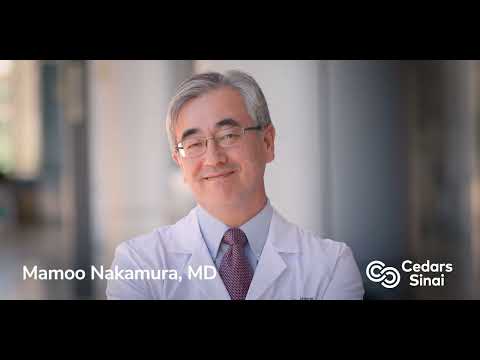

Video available online at:
https://www.youtube.com/watch?v=3sGELhZxSZY

3 Patient Reviews for
Dr. Nakamura
"Mine is a story of self-advocacy. It is a story of two diagnoses, two doctors, and one simple surgical solution that took me to a better place. I knew of my two diagnoses from diligently following up with doctors over the years. I had also done my homework on the internet and by talking with friends and clients I trust. Research would add a layer of understanding that transformed my experience. And as soon as I was aware that I had both an aortic aneurysm and an aortic valve that needed to be replaced — I knew that as long as my aneurysm didn't require immediate surgery — that I wanted to have my aortic valve replaced without a sternotomy, which means having my sternum cut open and my ribs spread apart. A minimally invasive procedure called a Transcatheter Aortic Valve Replacement (TAVR) makes this possible.
With a TAVR, a small incision is made in the groin enabling the surgeon to run a catheter through my femoral artery and up through the blood vessel in the center of my body — where it can then be guided into place in my heart. Having an aortic heart valve replaced this way takes just over an hour and leaves no postoperative discomfort other than the healing of the small incision in the groin. The sternotomy required by fully open surgery means a sore chest from a cut and separated sternum sometimes results in broken ribs. I had experienced broken ribs from a motorcycle accident years ago, and I didn't want to repeat the experience of pain with every laugh and cough. The TAVR procedure would make this faster and less uncomfortable recovery possible. Having my aortic valve replaced this way became my goal.
Unfortunately, in my case, arranging for a TAVR wasn't as easy as I had thought. My cardiologist was great, and promised to send my charts to any surgeon that could perform my procedure. But when I consulted with surgeons at another institution, I was told that I would not qualify for a TAVR due to the shape of my heart and the severity of the calcification of my valve. This calcification is known as aortic stenosis, and they also told me that it would intensify my risk of having a stroke during the procedure. Another warning was that there might be risks from the anesthesia, which seemed odd, because TAVR's are now so common. For this reason, the other institution said that I would have to have a traditional SAVR, or Surgical Aortic Valve Replacement. I immediately found myself in the "TAVR versus SAVR" debate. But as a CPA with 1000 clients, it was easy for me to find ten who had had TAVR's. All of them spoke highly of the procedure and handled the anesthesia without incident. The objections being raised by the other institution seemed manipulative and contrived. This is when my self-advocacy kicked into high gear, and I decided that it was time for a second opinion.
All the homework I had done online told me where to go, and the place to go is to Cedars-Sinai and to Dr. Joanna Chikwe, the Director of Cardiac Surgery. Consulting with Dr. Chikwe was a breath of fresh air. She took an entire hour with me to review my diagnosis in detail. Dr. Chikwe has a wonderful patient manner. She is very calming and knowledgeable, putting patients at-ease with her kindness and vast knowledge — which she then shares with great understanding for her patients' concerns. Prior to meeting with Dr. Chikwe, I had had an MRI and CAT scan at the prior institution. She reviewed both and was able to explain them to me in detail. Dr. Chikwe felt that I could, indeed, be a candidate for a TAVR. She also concluded that my aortic aneurysm, which at 4.5 cm was still half a centimeter below the 5 cm threshold for surgery - could be controlled without immediate surgery through blood pressure medications. This process is called medical management, and its effectiveness must be continuously monitored with daily blood pressure checks and scans every three to six months to ensure that the aneurysm has remained below the 5 cm threshold.
With my aneurysm at a non-surgical point for now, Dr. Chikwe was able to address my aortic valve. She did feel that I was indeed a candidate for TAVR, and she then referred me to Dr. Mamoo Nakamura, an interventional cardiologist specializing in TAVR. My consultation with Dr. Mamoo Nakamura was also a reassuring and calming experience. Dr. Nakamura reviewed my prior scans and also assured me that the minimally invasive TAVR was an absolutely workable solution for me. He also assured me that it was perfectly fine to schedule my procedure in November so that I could take care of over 300 clients with tax filing deadlines. And the timing worked out well with how I had felt. Up until then, I had been asymptomatic. It wasn't until about two weeks prior to my surgery that I started to feel sluggish, which was perhaps the result of my defective aortic valve not enabling enough oxygenated blood out into my body. It was clear that the time for my surgery had arrived.
When the day of my TAVR came, everything seemed so quick and easy. The entire procedure of replacing my aortic valve with the catheter through my groin took just one hour and fifteen minutes. As I awoke, the nurse asked me how I felt. "I'm ready to play five rounds of rugby," I joked. I went home the very next day with no sternotomy. My surgery was on Thursday. I was home on Friday. And by Monday, I was already working half days. Within a week, I was out walking around again and going about my normal life. And the few discomforts were relatively minor in comparison what they might have been with fully open surgery. While at first I felt great, there were a few days after the surgery where I felt a bit uncomfortable with the steristrips over my groin incision. But they stayed on in the shower and felt better within days. There was also some bruising on my right side. The nurses said this was normal and that it would also go away within a week, and it did.
Throughout my experience with both Drs. Chikwe and Nakamura, I was constantly supported by their care and scheduling teams. When I first called Dr. Chikwe, her scheduler, Mary, and her nurse practitioner, Vivian, were both incredibly kind and helpful. And Dr. Nakamura's nurse practitioner, Katherine Brow was just great as she helped me during my surgery and office visits. Dr. Nakamura's scheduler, Auz, was simply terrific as she called me frequently to check on me. The pride that this team takes in their work really shows - and truly helped me as a patient.
It has now been almost three months since my TAVR. The experience of the surgery itself seems just as minimal as the term "minimally invasive" would imply. Looking back at this point, there isn't much to say about the actual surgery and that's the entire beauty of it. My valve was replaced quickly and efficiently with a TAVR and with relatively little discomfort. I was back to my normal routine within days. My new valve works, and I feel as energetic as ever.
But what does stand out in my mind now is what I learned through my own self-advocacy and self-care experiences. I started this entire journey with two diagnoses – one for my aortic valve, and one for my aneurysm. My new valve will last fifteen to sixteen years before needing to be replaced again. As for my aneurysm, I will need to make every effort to medically manage my blood pressure with medications and report for regular scans.
As a self-advocate, I am so glad that I sought a second opinion at Cedars-Sinai with Dr. Chikwe and Dr. Nakamura. I have already recommended both surgeons five times to friends and clients for their own heart care needs. My experience has left me feeling that Cedars-Sinai is the only place to go in Los Angeles for heart surgery. My fifty-year career as a leading CPA and accounting instructor at the college level has taught me to be savvy in reading how behavioral clues relate to competence. As an observer of people — that means that the stubborn hubris unfurled upon me by the rival institution in insisting that a sternotomy was my only option merely turned me off and drove me to seek answers elsewhere. When online research told me that Cedars and Dr. Chikwe was the right "elsewhere" to seek answers with, it was their gentle and straightforward delivery of the honest truth that impressed me immediately and won me over.
Dr. Chikwe and Dr. Nakamura are truly in it just for their patients and are not emboldened by excessive pride in their program or the desire for more profitable, fully invasive procedures when minimally invasive options truly can work. Dr. Chikwe and Dr. Nakamura will do whatever they can to make minimally invasive surgery available for their patients whenever the patient's diagnostics show that it is possible. The esprit de corps of their entire care teams – their nurses and their schedulers – make an entire culture of their caring and gentle ways. I approached my diagnoses for my aortic valve and aneurysm wanting a minimally invasive solution if it could be done.
Dr. Chikwe and Dr. Nakamura took the time with me to show me that in my case, a TAVR really was possible for my valve, and that medical management for my aneurysm is a good strategy moving forward. In so doing, they gave me a good plan for my future and got me where I want to be with as little discomfort as possible. I arrived in this satisfied place because I found two great surgeons. Doing my homework and advocating for myself really did pay off."
"Dr. Nakamura saved my life three times. My journey with him began a few days before my husband’s birthday in June 2024. As each day passed, I felt lethargic. My energy kept dropping. I was planning a birthday party for my husband with 400 people. Wild horses couldn’t have kept me from that party. But my husband did. “You’re looking grey,” he said. “You’re going to Cedars critical care.” When we arrived at the Hillhurst branch in Los Feliz, the nurse took one look at me and called an ambulance to take me to a hospital. I insisted upon being taken to Cedars.
Once there, things happened quickly. My cardiologist, Dr. Zimmer, looked at me and said “your main artery is 97% occluded….you’re going to be here for a few days...” Now I was upset. It was Friday and my husband’s party was coming up on Sunday. This was a very inconvenient time for a medical crisis. I didn’t have time for a heart attack. I needed action. “Let me see what I can do…I know Dr. Manoo Nakamura, an interventional cardiologist,” Dr. Zimmer said. Then, at 5:30 am the next morning – a Saturday – Dr. Nakamura appeared. “Something about a party?” he asked. “Yeah, it’s important,” I replied. Then he said he could have a team assembled at 8 am to stent my artery so I could be home on Sunday for the party. Suddenly, Dr. Nakamura was my hero! He could stent my artery, stave off a heart attack – and have me home for my husband’s birthday party the next day! I would have to take it easy. But I could be there. And this was my first lesson from Dr. Nakamura that minimally invasive procedures make life-saving efficient.
Dr. Nakamura’s assessment also revealed that I would soon need an aortic valve replacement. And sure enough, after the stent, my chest kept hurting and I still had shortness of breath. During the next few months, Dr. Nakamura’s nurse practitioner, Pamela Mondajar, continued to be very helpful. I kept seeing my diagnostic cardiologist, Dr. Zimmer, and was in constant contact with Pamela and other members of Dr. Nakamura’s staff. All of them are so knowledgeable, helpful, and amazing. Dr. Nakamura’s staff made all my appointments so smooth and easy. When it was time for my next minimally invasive procedure with Dr. Nakamura in November – a TAVR to replace my aortic valve by sliding a catheter through my groin – I was in the hospital for just two days. Again, Dr. Nakamura had saved me from having my chest cut open with a minimally invasive procedure. But my heart challenges didn’t end there.
Fortunately, my supportive relationship with Dr. Nakamura and his staff continued right along to help me keep fighting those challenges. My husband and I became so comfortable at Cedars that we called it “the ranch.” Over the next five months, the pain in my chest continued. I kept dismissing the stabbing pain as the stent. But when I turned grey again, my husband said, “it’s time to go to the ranch.” Sure enough, the scan showed that a tear in my mitral valve was filling my lungs with fluid and blood. This explained my shortness of breath and why I kept feeling worse. Dr. Nakamura said he could fix this with a mitral clip. And once again, he was my life-saving hero who repaired my heart with a catheter procedure and sent me home within a few days.
My heart is better now, and I feel great. I credit coming through three serious cardiac events to being surrounded by angels. First, my husband, who prioritizes my well-being over all else. And second, Dr. Nakamura, Dr. Zimmer, Pam, and their entire team. I run a nightclub and organize music festivals for thousands of people. Life is good. To keep it that way, great healthcare means everything to me. Thanks to Dr. Nakamura having minimally invasive methods to save my life three different ways, I can continue to live life to the fullest. And my heart, my music, my joy, and my friendships — haven’t missed a beat!"

My Specialties &
Clinical Interests
My specialties include:
-
 Transcatheter aortic valve replacement
-
Transcatheter mitral valve repair and replacement
-
Transcatheter tricuspid valve repair and replacement
In addition, I have research and clinical interests specific to:
-
Clinical outcome research of structural heart disease interventions, specifically related to transcatheter aortic valve replacement and transcatheter edge-to-edge repair of mitral regurgitation.

Education, Training & Certificates
Dr. Mamoo Nakamura, interventional cardiologist, graduated from Mie University School of Medicine, Japan in 1993.
Dr. Nakamura is the Associate Professor of Cardiology and the Associate Director of the Cardiac Intervention Center at Cedars-Sinai Medical Center. He is board certified in Internal Medicine, Cardiovascular Disease, Heart Failure/Transplant Cardiology and Interventional Cardiology.
As a specialist in minimally-invasive heart valve therapy, Dr. Nakamura completed the following residencies and fellowships:
Clinical Fellow (Interventional Cardiology), Division of Cardiology, Cedars-Sinai Medical Center, Los Angeles, California, July 2011 to June 2013
Clinical Fellow (Cardiovascular Medicine), Cardiovascular Division, University of Miami/ Jackson Memorial Hospital, Miami, Florida, July 2008 to June 2011
Clinical Fellow (Heart Failure/Transplantation Cardiology), Cardiovascular Division, University of Miami/ Jackson Memorial Hospital, Miami, Florida, July 2007 – June 2008
Intern and Resident, Internal Medicine, Department of Medicine, University of Pittsburgh Medical Center, Pittsburgh, Pennsylvania, June 2004 – June 2007
Postdoctoral Fellow, Division of Cardiovascular Medicine, Stanford University School of Medicine, Stanford, California, July 2000 – June 2004
Intern and Resident, Internal Medicine, Okinawa Chubu Hospital, Gushikawa, Okinawa, Japan, May 1993 – April 1995.

Schedule Appointment with Dr. Mamoo Nakamura, MD
To schedule an appointment with Dr. Nakamura, you can:
-
Call (424) 260-9439 right now
-
The office of Dr. Nakamura is located at 127 S. San Vicente Blvd., Suite A3600, Los Angeles, California 90048. To get driving directions to this office, please click the map below.

News & Online References Featuring Dr. Mamoo Nakamura
Here is the latest news featuring Dr. Mamoo Nakamura: