
Pig Valve Replacements: 10 Important Facts
Page Last Updated: May 9, 2025
When patients learn they need heart valve replacement surgery... Several questions often race through their minds including "Will I be okay?", "What should I do next?", "Which doctors and hospitals can I trust?" and "What will my recovery be like?".
Another important question is, "Which heart valve replacement should I choose?" The answer to this question, in itself, can be overwhelming and agonizing. So, let's break it down into smaller pieces.

Epic Pig Valve Replacement (Abbott Laboratories)
Heart Valve Anatomy
There are 4 chambers in the heart through which blood flows. These are the right atrium, right ventricle, left atrium and left ventricle. The atria act as blood receptacles and the ventricles act as pumps. In order for the blood flow to move in a unidirectional fashion, the heart is equipped with four valves that separate each of these chambers. The valves have evolved over time to ensure little or no backflow takes place. These valves are:
Aortic: located between the left ventricle and aorta
Mitral: located between the left atrium and left ventricle
Tricuspid: located between the right atrium and right ventricle
Pulmonary: located between the right ventricle and the pulmonary artery
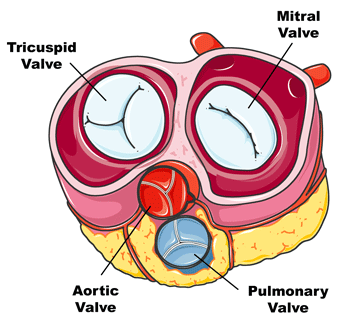
Blood flows between the atria and ventricles, alternately, as the heart muscle contracts and relaxes. When each of the valves is healthy and operating as they should, un-oxygenated blood flows from the right atria to the right ventricle through the tricuspid valve. It then moves from the right ventricle to the lungs through the pulmonary valve, picking up oxygen before collecting in the left atrium. The oxygenated blood moves into the left ventricle through the mitral valve. From here, the blood is pumped into the aorta, through the aortic valve, for distribution to the entire body.
The two main forms of heart valve disease are stenosis and regurgitation. Stenotic valves are "narrowed" which negatively impacts the blood flow from the heart to the rest of the body. Regurgitant valves leak and force the heart to re-pump blood. The two most common forms of heart valve disease are aortic stenosis and mitral regurgitation.
Heart valve disease, like many cardiac conditions, range from mild to severe and progress over time. Symptoms that patients with heart valve disease my experience include shortness of breath, chest pain, leg swelling, abnormal heart rhythms (atrial fibrillation) and fatigue. Patients with moderate-to-severe and/or severe heart valve disease may need a heart valve replacement procedure to prevent heart failure and/or death.
Biological or Mechanical Heart Valve Replacement?
Patients and their medical teams must choose whether to use a biological or mechanical valve to replace the diseased valve. Ask your cardiologist for information about both types. He or she may have a preference or more experience with one or the other. The point is, it is your right to make an informed choice!!!
Biological valves are made from animal tissue. They are fashioned from pig, cow, horse, or human (donated) tissue. The animal tissue type is called a xenograft. The human (from a donated heart) type is called an allograft or homograft. The valves are treated to mitigate the need for anti-rejection medications.

On-X Mechanical Valve Replacement
Mechanical valves are made from a strong material, such as carbon. These valves are more durable than biological valves. A consideration prior to selecting a mechanical valves is that patients currently need to take blood thinners (warfarin) to prevent clot formation on the valve for the rest of their life.
About Pig Valve Replacements
For over 30 years, pig valves have been successfully planted in humans. Interestingly, a pig's heart is similar in size, weight, and structure to a human's heart.
Hearts are harvested from freshly killed pigs. This is done under clean conditions and the porcine tissue is refrigerated right away. Contrary to what some believe, pigs are not grown specifically for the harvesting of their hearts. The pigs that are used for medical purposes are grown for human consumption.
Under sterile conditions, the valves are removed from the pig's body. The excess tissue and myocardium are then removed. The valves are then "sized" so they are appropriately fit when implanted into a human. That's right! We all have different size heart valves similar to different size feet.
The pig valve is typically mounted to a stent (frame) that can be reinforced with Dacron cloth and sutures. After mounting, the valve is checked microscopically and cultures are taken. Cotton can be used to maintain proper structure (geometry) and the valve is placed in a sterile cup. To preserve the tissue, the valve is often placed in glutaraldehyde to reduce possible failure or rejection of the valve by the recipient.
Porcine valves last an average of ten years; give or take a few years. But, some have lasted much longer - up to seventeen years! Typically, pig valve replacements wear out faster in younger, more active individuals.
Structural valve deterioration of pig valves (also known as porcine valves) was found to be accelerated in young to middle-aged people. Some of these younger patients needed another valve replacement surgery within 4-7 years after the original procedure. The highest success rate of pig valve replacements was found in patients over 60 years of age.
In one large randomized trial, comparing mechanical valves with porcine valves, researchers found that survivability was increased with the use of a mechanical valve compared to a pig valve in the aortic position (76% vs. 66%) but no significant difference for those who had undergone mitral valve replacement. In a second study, lasting twenty years, there was little to no difference noted in survivability rates.
Types of Pig Replacement Valves
Today, there are many different heart valve replacement devices available to patients. So, it is vital to find and "team up" with your cardiologist and surgeon during your valve selection process. It is important that your choice of valve replacement and implantation approach is very familiar to your surgeon.
As mentioned above, the primary drawback of a pig valve replacement is failure due to structural degeneration within 10 to 15 years. This progressive tissue degeneration can be caused by calcification and collagen deterioration. To combat this, biological valves may undergo two involved processes: fixation and anti-calcification.

Epic Pig Valve Implanted in Mitral Position
To prevent calcification, St. Jude (now Abbott) developed an anti-calcification treatment that can be used on porcine and cow (bovine) tissue. Abbott patented and trademarked this protective treatment under the name of Linx AC technology. Abbott combined the new Linx AC method with their reliable Biocor valve to produce the Epic stented bioprosthetic valve. The result has been an extended duration of time before the Epic valve needs another replacement.

Mosaic Pig Valve Replacement
Medtronic uses a unique tissue preservation method called Physiologic Fixation. This process preserves the valve's leaflet structure. It uses the AOA (AOA, Biomedical Design, Inc, Atlanta, Georgia) treatment process to mitigate tissue calcification, thereby extending valve life and durability. The Mosaic and Mosaic Ultra are two examples of the replacement valves Medtronic produces.
Different Heart Valves for Different Patients
As many cardiologists and surgeons will tell you, there is no "perfect" heart valve replacement. Each valve has its pros and cons. There is a multitude of factors that patients should take into consideration before a choice is made.
In this decision-making process, a patient's age, gender, activity level, underlying disease, the durability of the replacement valve, and the impact of "blood thinning" meds, if necessary, should be factored into their choice. There's a lot of information to sift through while deciding on a heart valve replacement.
I am hopeful this article helped you learn more about pig valve replacements.
You May Also Like:
Why Does Dr. Starnes Implant Pig Valves In The Mitral Position?
Transcatheter Valve-in-Valve Re-Operations: What Should Patients Know?
Resources:
American Heart Association
-https://www.heart.org/en/health-topics/heart-valve-problems-and-disease/understanding-your-heart-valve-treatment-options/types-of-replacement-heart-valves
Harvard Medical School
https://www.health.harvard.edu/heart-health/valve-replacement-mechanical-or-tissue
University of Michigan
-https://medicine.umich.edu/dept/cardiac-surgery/patient-information/adult-cardiac-surgery/adult-conditions-treatments/heart-valve-replacement
University of Wisconsin
-https://www.uwhealth.org/heart-cardiovascular/aortic-valve-repair-or-replacement-surgery/11107
Harvard Medical School
-https://www.health.harvard.edu/heart-health/valve-replacement-mechanical-or-tissue
Mayo Clinic
-https://www.mayoclinic.org/tests-procedures/heart-valve-surgery/about/pac-20384901
Sentara
-https://www.mayoclinic.org/tests-procedures/heart-valve-surgery/about/pac-20384901
Annals of Thoracic Surgery
-https://www.annalsthoracicsurgery.org/article/S0003-4975(10)65683-4/pdf
BMJ Journals
-https://openheart.bmj.com/content/5/1/e000672
Columbia Surgery
-https://columbiasurgery.org/conditions-and-treatments/aortic-repair-replacement
Cost Helper
-https://health.costhelper.com/valve-replacement.html
https://images.app.goo.gl/VjGf3qEkcHt37u717
Aspirus Heart and Vascular
-https://www.valvedisease.org/index.cfm?pid=3&pageTitle=Valve-Anatomy-&-Function
Cleveland Clinic
-https://health.clevelandclinic.org/heart-valve-replacement-which-type-is-best-for-you/
National Library of Medicine
-https://pubmed.ncbi.nlm.nih.gov/22877802/
National Library of Medicine
-https://www.ncbi.nlm.nih.gov/pmc/articles/PMC1767148/
National Libray of Medicine
-https://pubmed.ncbi.nlm.nih.gov/28444168/
tctMD/ The Heartbeat
-https://www.tctmd.com/news/st-jude-medical-furthers-companys-legacy-heart-valve-excellence-us-launch-trifecta-surgical
Animal Tissue Valves
-https://www.pages.drexel.edu/~rjb56/Animal%20tissue.htm
The Journal of Heart Valve Disease
-https://www.icr-heart.com/?cid=2827
Abbott/Structural Heart Solutions
-https://www.structuralheartsolutions.com/us/structural-heart-products-solutions/mitral-valve-epic/overview/
Hospital Healthcare Europe
-https://hospitalhealthcare.com/latest-issue-2015/biological-aortic-heart-valve-calcification/
Science Direct
-https://www.sciencedirect.com/science/article/pii/S0022522314002700
AHA Journals/Circulation
-https://www.ahajournals.org/doi/full/10.1161/circ.100.suppl_2.ii-17
Medtronic
-https://www.medtronic.com/us-en/healthcare-professionals/products/cardiovascular/heart-valves-surgical/mosaic-mosaic-ultra-bioprostheses.html
Written by Adam Pick
Patient & Website Founder

Written by Adam Pick - Patient & Website Founder
Adam Pick is a heart valve patient and author of The Patient's Guide To Heart Valve Surgery. In 2006, Adam founded HeartValveSurgery.com to educate and empower patients. This award-winning website has helped over 10 million people fight heart valve disease. Adam has been featured by the American Heart Association and Medical News Today.
New Patient Posts



Heart Hospital Map

Search for heart hospitals that specialize in heart valve treatment.