Mitral Valve Prolapse: What Should You Know?
One of the most common forms of heart valve disease is mitral valve prolapse. According to the American Heart Association, approximately 2% of the population has some form of this mitral valve disorder.
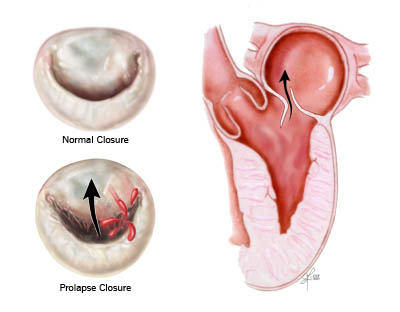 Diagram of Mitral Valve Prolapse
Before we discuss the details of mitral valve prolapse, its symptoms, risk factors and treatment, let's review the anatomy of the mitral valve and the functioning of this two-leaflet valve in the human heart.
What Is The Mitral Heart Valve?
The mitral valve is one of four heart valves inside the human heart. The mitral valve controls the flow of blood between two chambers in your heart called the left atrium and the left ventricle. In normal functioning hearts, blood flows in one direction across the mitral valve - from the atrium to the ventricle.
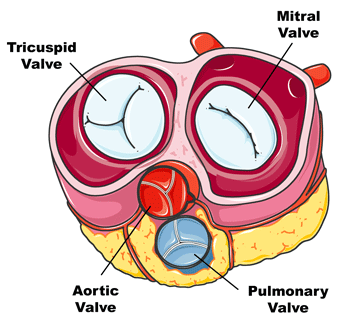
Diagaram of the Human Heart Valves
Unlike the other three heart valves (aortic, pulmonary, tricuspid), the mitral valve is unique in that it has only two leaflets. The other human heart valves each have three tissue leaflets.
When the heart relaxes, the two mitral leaflets (also known as flaps) swing open to let blood flow from the atrium to the ventricle. The leaflets are supported by the mitral valve annulus, a saddle-shaped structure responsible for maintaining the structure of the mitral valve.
What Is A Mitral Valve Prolapse?
If you have mitral valve prolapse, the leaflets of the mitral valve do not seal properly.
One of the leaflets moves back into the atrium when the heart beats. Because of this "prolapse", blood flows back into the heart. This is frequently referred to as a leaky heart valve, or more specifically mitral regurgitation.
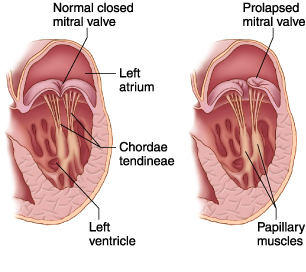
Here is an excellent diagram which compares a normal mitral valve to a prolapsed mitral valve. As you can see, the two mitral leaflets do not seal together. As a result, blood can flow back into the heart.
Who Gets Mitral Valve Prolapse?
Reports suggest that one in twenty Americans have some form of mitral valve prolapse.
People are usually born with mitral valve prolapse as a congenital condition. Over a patient's lifetime, however, the disease can become degenerative as the anatomical structures of the mitral valve age. Research suggests that 20% of people over the age of 50 have some form of mitral valve disease.
Specific to gender... Women suffer from this disease twice as much as men. In fact, some studies show mitral valve disease affects six percent of all women.

Compared to other heart valve disorders (e.g. aortic stenosis), mitral valve prolapse (also referred to as MVP) is the most common valvular disorder.
What Are Mitral Valve Prolapse Symptoms?
The Cleveland Clinic suggests that the symptoms of mitral prolapse are:
- Feeling like your heart is racing or is skipping beats
- Heart Palipitations
- Chest pain that comes now and then
- Shortness of breath
- Dizziness
- Anxiety
Your doctor can diagnose mitral valve prolapse during a regular exam. When listening to your heart with a stethoscope, your doctor may hear a clicking sound. The defective heart valve leaflet can make a pronounced "click" as it opens and closes.
If blood is flowing back into the atrium, your doctor will hear a "whooshing" sound. This sound is called a mitral valve murmur and is caused by the mitral valve prolapse.
To find out if you have mild, moderate or severe mitral regurgitation due to mitral prolapse, your cardiologist may require an echocardiogram. An echocardiogram provides a picture of your heart that shows and quantifies heart valve efficiency as blood flows through the heart. Echocardiograms and other medical tests can help your doctor determine if your mital valve needs surgical repair or replacement.
What Are The Risks?
There are several risks associated with severe mitral valve regurgitation that result from mitral valve prolapse. According to the Mayo Clinic, complications from this disease include:
- Heart failure
- Atrial fibrillation
- Pulmonary hypertension
If left untreated, mitral valve disease can result in death, according to Dr. Patrick McCarthy, the Executive Director of the Bluhm Cardiovascular Institute at Northwestern Memorial Hospital in Chicago, Illinois.
How Is Mitral Valve Treated?
There are two types of treatment available for mitral valve prolapse:
Mitral Valve Repair: During a mitral valve repair procedure, the patient's mitral valve is reconstructed to ensure proper blood flow through the heart. The repair may include reshaping the mitral valve leaflets, strengthening the mitral annulus with an annuloplasty ring and/or fixing the mitral chordae. Typically, mitral valve repair surgery is an open-heart procedure. However, there are new transcatheter approaches for mitral valve repair which do not require an incision to the patient's sternum or ribs. For example, the MitraClip is an FDA-approved transcatehter mitral valve repair device that "clips" the malfunctioning leaflets together in an effort to prevent mitral regurgitation. It should be noted that the MitraClip is only available for certain patient populations.
Mitral Valve Replacement: For patients with mitral valves that are not repairable, there are several different types of mitral valve replacement devices that can restore heart valve function. Typically, this is an open-heart procedure. However, there are new transcatheter mitral valve replacement technologies that are now in clincal trials and feasibility studies.
You May Also Like
To help you learn more about mitral valve prolpase and its treatment options, here is additional educational information and patient success stories to educate and empower you:
- New Findings: Mitral Valve Repair for Mitral Regugitation Restores Life Expectancy
- Clinical Trial Update: MitraClip is a "Game Changer" for Mitral Prolapse Patients
- Patient Video: Why Did Janet Want a Heart Valve Repair for Mitral Prolapse?
- Free Patient eBook: Advantages of Mitral Valve Repair
- Before & After Surgery Pictures: Tim's Leaking Mitral Valve
- Meet Patients with Mitral Prolapse in Our Community!
Page last updated: December 18, 2022
Written by Adam Pick
- Patient & Website Founder