Pssst… Don’t Forget To Use Your Incentive Spirometer!
Hey everybody,
Just a quick reminder to use your incentive spirometer following heart valve surgery. I know it is somewhat laborious and it can be painful but the incentive spirometer is one of the best ways to manage fluid in the lungs following cardiac bypass surgery. The incentive spirometer can also protect against collapsed alveoli which can lead to pneumonia.

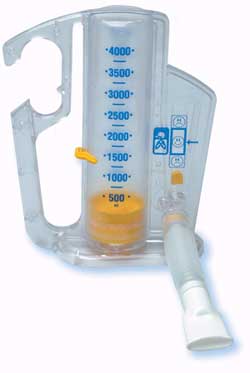
An Incentive Spirometer
I just received this email from Kathy which emphasizes this point. Kathy had aortic valve replacement on February 11.
“Adam - Currently, I still have some fluid around the heart. I also have a bit of fluid in both lungs after surgery. The right lung, if it does not resolve itself, may have to be drained with a needle. I am finally using the spirometer regularly which is part of the doctor’s recommendation. I guess it’s not too late. I was in such discomfort before. Plus I had a dry, unproductive cough in the hospital, that I stopped using the spirometer. My next echo is March 28th. The echo I had a few days ago indicates, that the fluid has improved. Evidently, the colchicine is working. Hoping for the best! Kathy”
Like Kathy, I also had some complications with fluid in my lungs after heart surgery. It took several days of frequent spirometer use but the painful breathing and fluid in my lungs did go away.
Keep on tickin!

P.S. To leave a comment, please click here.
About The Author: Adam Pick is a double, heart valve surgery patient and author of The Patient’s Guide To Heart Valve Surgery. This unique book integrates the clinical facts of heart valve surgery with the personal experiences of 78 former valve surgery patients to help patients and caregivers better understand the problems, the opportunities and the realities of heart valve surgery. To learn more about Adam and his heart valve surgery book, click here.
- Previous: Is Heart Valve Surgery Advisable For Elderly Patients Over Eighty Years Old?
- Next: Mitral Valve Leakage And Stress


March 15th, 2008 at 5:39 pm
Hello everybody!! I think that the spirometer excercises are often not given the importance they have. Is just a matter of discipline, I’ve done it myself in a hip surgery I had long ago and it was THE difference for me. I will like to express here something that my husband Sergio experienced and maybe Adam can check it out: Since before surgery Sergio was taking a lot of medicines and one of them was Tritace composed of Ramipril, doctors still gave him that medicine after the surgery because it helps the pumping of the heart. It is a very common medicine for the heart and sometimes it produces COUGHING dry unproductive cough as Kathy mentions!!! as soon as he stoped taking it he stopped coughing so my advice is if you have cough and you’re taking Ramipril ask your doctor about it!!!
See you……
March 17th, 2008 at 1:21 am
Dear Adam and fellow valve surgery patients!
As to the incentive spirometer, you cannot imagine how much difference this makes in a patient’s progress and the speed of their recovery. I have had abdominal surgery twice before, and on top of that, I hold a BSRC (Bachelor of Science in Respiratory Care) degree from Texas Sate University, I have one year to go on my Masters. incentive spirometers promote deep breathing by a sort of inspatory biofeedback to retrain the breathing muscles. They work extremely well when used properly. Prior 15 years ago, a Positive pressure device called an IPPB was used for this expanding the lungs, but the thing that was lacking with IPPBs was the use of inspiratory muscles. In fact, It used to be that people would often have successful surgeries and die shortly after due to pneumonia. This is not so long ago! Things have gotten better but one must use them religiously or the are just nothing but plastic toys for your kids’ enjoyment. With deep inspiration, you not only stretch the alveoli and lung tissue, it causes secretion of a wonderful substance called surfactant which allows the lung to be less stiff or more compliant. Therefore, pneumonia will be far less likely.
Hint: Using a pillow held tightly on the wound while using an incentive spirometer, while deep breathing and while coughing helps immensely by preventing too much movement of the sternum or other painful wound. This keeps the pain to a minimum, but it still hurts
I am due to go in for a Ross Procedure in ~ 2 weeks. I just read your great book and found it very enlightening. Everyone undergoing Heart Surgery should read it. All though most of it I knew from studying and practicing RC, the whole recovery process was quite shocking and yet definitely “a need to know” in many ways. My family is medical, too and, yet, the book was very helpful in explaining a whole lot to my family and friends. Believe me, they had no clue!
Thank you for writing this wonderful easy to understand book.
I have two or three suggestions to share:
1. We in Respiratory Care are called either Registered or Certified Respiratory Therapists (RRT’s or CRTT’s) (This is much like LPN’s, LVN’s and RN’s) these Certifications must be earned by a long, intense and well rounded education followed by Board Exams which are considered far more comprehensive and difficult than those given to RN’s. For those of us in the field, using “respiration therapy” is almost as insulting as calling us “Oxygen orderlies.”
2. One should NEVER actively “blow on the incentive spirometer” except when PASSIVELY exhaling. Rather, it is an inspiratory maneuver. Blowing may cause collapse of small airways and make your problem worse! So suck on it or inhale on it would be more appropriate than BLOWING !
3. You may not know this, but we RT’s are the ones that are supposed to instruct in proper use of IC and Respiratory Therapy devices like your nebulizer with steroids (there was probably a broncodilator in there, too to keep your airways from collapsing from the steroids.)
4. It may also interest you to know that, your Respiratory Care Professional was undoubtedly the one who meticulously controlled and maintained your ventilator (breathing machine) and your endo tracheal tube so that you could continue to breathe when you where not able to do so on your own!!
The profession of RT and RC, would greatly appreciate it if you would make these corrections or at least mention the RCP’s true role in your great recovery.
Thanks again for your book. It is a great help!
Yours,
Jim Spector, BSRC, RRT, CRTT, RPSGT
June 2nd, 2008 at 8:14 pm
I just had a sigmoidectomy last week. I was ready to leave the hospital yesterday when my temperature suddenly spiked to 101.5. I hadn’t been using my spirometer.
I totally underestimated the importance of this little device. Even if it doesn’t cause medical complications, in my case it caused an extra day in the hospital climbing the walls!